
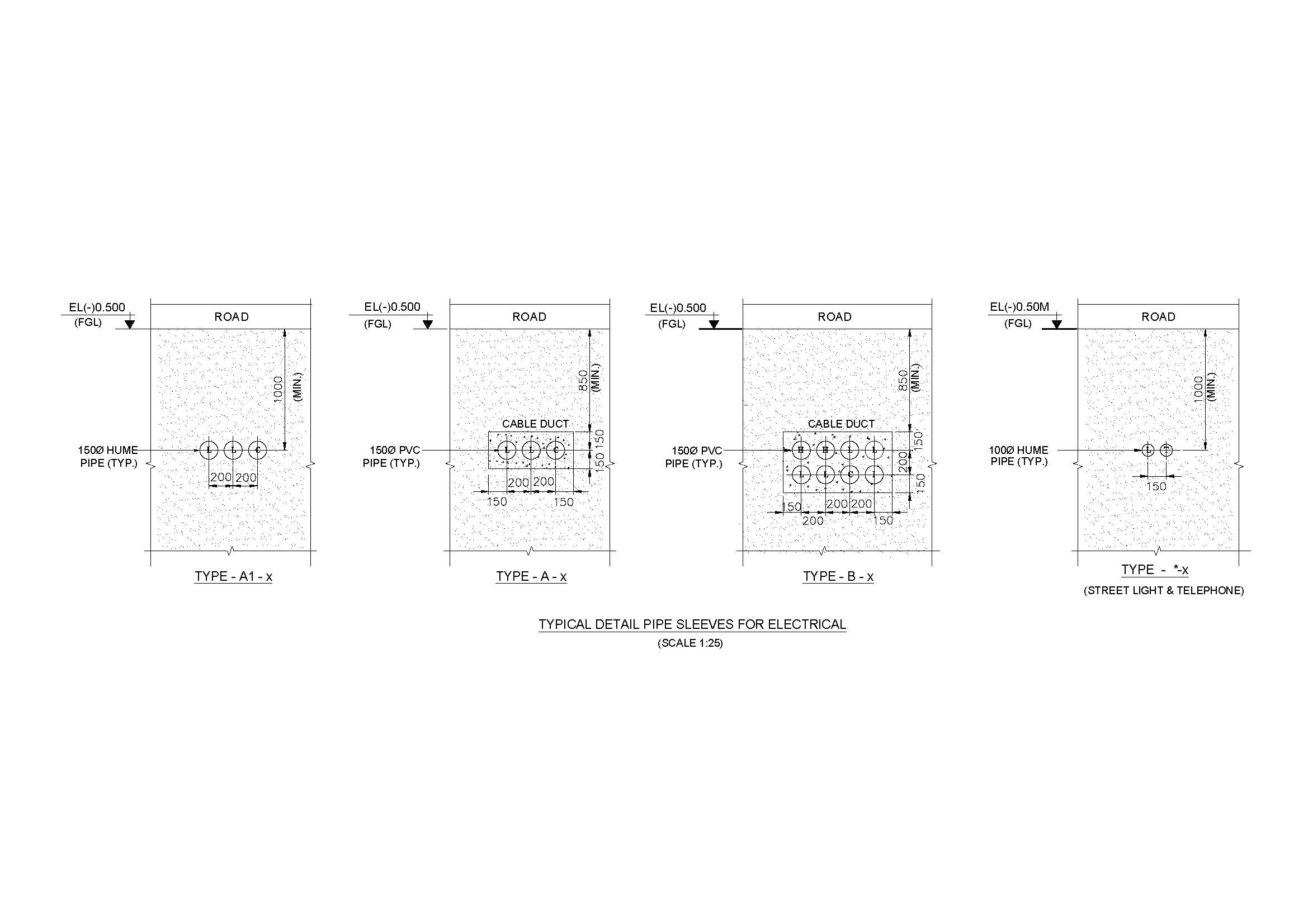
Duct Bank Details and Pipe Sleeves Details
A duct bank is an underground network of conduits (typically PVC, HDPE, or concrete) encased in concrete to provide a protected pathway for electrical cables, communication lines, or other utilities. Duct banks are widely used in industrial plants, power distribution networks, and commercial infrastructure to organize and protect cables from physical and environmental damage.
1. General Layout Drawings
- Duct Bank Plan View:
- Shows the routing of the duct bank.
- Includes:
- Conduit alignment.
- Turning points and offsets.
- Junction or pull box locations.
- Cable entry/exit points.
- Duct Bank Elevation View:
- Displays depth, conduit arrangement, and changes in elevation.
- Includes:
- Trench depth and width.
- Transition sections (e.g., rising from buried sections to above ground).
- Pull box placement.

2. Cross-Section Drawings
- Typical Duct Bank Cross-Section:
- Conduit arrangement:
- Single-layer or multi-tier configuration.
- Details of spacing between conduits:
- Horizontal: 75–100 mm.
- Vertical: 75–150 mm.
- Concrete encasement thickness:
- Minimum 75 mm on all sides.
- Reinforcement (if applicable):
- Placement of rebar or mesh.
- Direct-Buried Duct Bank Section:
- Shows conduits placed directly in the trench.
- Includes:
- Sand or gravel bedding layer (typically 150 mm).
- Warning tape placement above conduits.
- Minimum cover (e.g., 600 mm for roads, 1 m for heavy loads).
- Multi-Tier Duct Bank Section:
- Illustrates stacking of conduits in vertical layers.
- Includes:
- Spacers between layers.
- Adequate concrete cover for thermal dissipation.

3. Termination and Transition Drawings
- Duct Bank to Manhole/Pull Box Transition:
- Shows conduit entry points into manholes or pull boxes.
- Includes:
- Spacing of conduits entering the box.
- Grouting or sealing methods.
- Duct Bank to Equipment Transition:
- Illustrates how conduits connect to transformers, switchgear, or other equipment.
- Includes conduit stubs and protective covers.
4. Trench Details
- Trench Excavation and Backfill Section:
- Details trench depth, width, and side slope (if required).
- Includes:
- Bedding layer material and thickness.
- Backfill material (e.g., soil, sand, or gravel).
- Warning tape placement.
- Joint Details for Precast Duct Banks:
- Explains how precast sections are joined on-site.
- Includes:
- Sealant or grout for water-tight connections.
- Anchoring methods.
5. Reinforcement Details
- Concrete Encasement Reinforcement:
- Placement of rebar or wire mesh in the concrete surrounding the conduits.
- Includes:
- Bar sizes and spacing (e.g., 10–16 mm bars, 200 mm c/c).
- Overlapping lengths and anchoring points.
6. Fire Barrier/Separation Drawings
- Fire-Resistant Barriers:
- For duct banks passing through fire-rated walls or floors.
- Includes:
- Firestop materials (e.g., intumescent seals).
- Conduit spacing and fireproofing thickness.
7. Other Important Drawings
- Expansion Joint Details:
- For accommodating thermal expansion in long duct bank runs.
- Includes joint material and spacing.
- Drainage Details:
- For duct banks in areas prone to water accumulation.
- Includes drain pipes, sumps, or weep holes.
- Cable Pulling Section:
- Shows methods for cable installation within the conduits.
- Includes pulling points, tension loads, and lubrication access.
1. Types of Duct Banks
Duct banks are classified based on purpose, construction method, and layout:
a. Based on Purpose
- Electrical Duct Bank:
- Designed for high-voltage or low-voltage power cables.
- Includes separation between phases for electrical safety.
- Telecommunication Duct Bank:
- Houses fiber optic cables or copper communication cables.
- Includes provisions for pulling cables and splicing points.
- Combined Utility Duct Bank:
- Integrates both electrical and communication cables in separate conduits.
- Often used in urban infrastructure to minimize excavation.
b. Based on Construction Method
- Encased Duct Bank:
- Conduits are embedded in concrete for protection and mechanical strength.
- Used in high-traffic or load-bearing areas to prevent damage.
- Direct-Buried Duct Bank:
- Conduits are buried directly in the ground without concrete encasement.
- Used in areas with minimal load or where cost is a priority.
- Precast Duct Bank:
- Precast concrete sections containing conduits are manufactured off-site and installed on-site.
- Suitable for modular and fast construction.
c. Based on Layout
- Single-Tier Duct Bank:
- Conduits are arranged in a single horizontal layer.
- Ideal for shallow installations.
- Multi-Tier Duct Bank:
- Conduits are arranged in multiple layers, stacked vertically.
- Suitable for high-capacity installations with limited space.
2. Duct Bank Construction Methods
a. Conventional Cast-in-Place Construction
- Excavation:
- Dig a trench to the required depth (typically 600 mm to 1.5 m) based on the type of cables and load requirements.
- Compact the base and add a bedding layer (sand or gravel).
- Conduit Installation:
- Place conduits on spacers to maintain alignment and spacing.
- Typical spacing between conduits: 75–100 mm (to allow for heat dissipation).
- Reinforcement:
- Place reinforcement bars or mesh if required for load-bearing applications.
- Concrete Encasement:
- Pour concrete (typically M25 or M30 grade) to encase the conduits.
- Ensure proper vibration to avoid voids.
- Backfilling:
- Backfill the trench with compacted soil or suitable fill material.
b. Precast Duct Bank Construction
- Precast Duct Sections:
- Pre-fabricated concrete sections containing conduits are manufactured off-site.
- Sections include pulling points or handholes.
- Installation:
- Place precast sections in an excavated trench and align them.
- Joint Sealing:
- Seal joints between precast sections to prevent water ingress.
- Backfilling:
- Backfill with compacted soil after installation.
c. Direct Burial Method
- Conduit Burial:
- Conduits are placed directly on a sand bed and buried without concrete encasement.
- Protective Cover:
- Use warning tapes or slabs above conduits for protection and identification.
3. Key Design Considerations
a. Conduit Materials:
- PVC:
- Lightweight, cost-effective, and corrosion-resistant.
- Suitable for most utility applications.
- HDPE:
- Flexible and impact-resistant.
- Common in areas with soil movement or seismic activity.
- Galvanized Steel:
- Used for industrial or heavy-duty applications.
- Corrosion-resistant coating required for underground installations.
b. Conduit Size:
- Standard sizes: 50 mm, 100 mm, 150 mm diameter.
- Size depends on cable diameter and number of cables.
c. Separation Between Conduits:
- Maintain at least 75 mm spacing for thermal dissipation.
d. Duct Bank Size and Configuration:
- Configure duct banks based on the number of conduits.
- For multi-tier banks, add vertical spacers between layers.
4. Testing and Inspection
- Conduit Testing:
- Perform mandrel testing to check for blockages.
- Air or water pressure testing for leak-proof conduits.
- Concrete Quality Testing:
- Ensure proper curing and compressive strength of encasement.
- Post-Construction Inspection:
- Verify conduit alignment, spacing, and encasement.
5. Standards and Codes
- IS 1255 – Installation and maintenance of power cables.
- NFPA 70 (NEC) – National Electrical Code for underground duct banks.
- BS 7671 – Requirements for electrical installations.
- IEEE 525 – Guide for the design and installation of cable systems.
6. Applications of Duct Banks
- Power Plants:
- Underground duct banks for distributing high-voltage cables.
- Urban Infrastructure:
- Used for communication and power distribution in cities.
- Industrial Plants:
- Protect cables from mechanical damage in heavy-duty environments.
- Data Centers:
- For high-density cable management.
Let me know if you’d like specific design calculations or drawings for duct banks!
- 3D HOUSE DESIGN (42)
- Auto Calculator – Civil & Structural Engineering Calculation Tools (14)
- Civil and Structural Design Calculations (89)
- Commercial Plans (9)
- East Facing House Plans (16)
- Engineering Concepts – Civil & Structural (265)
- Excel Spreadsheets (37)
- Free Downloads (55)
- House Plans (65)
- Industrial standards (113)
- North Facing House Plans (16)
- South Facing House Plans (16)
- West Facing House Plans (14)
- AISC Beam to Beam Bolted Shear Connection Calculator

- Canadian Beam Design Calculator | Beam Load Calculator

- Australian Beam Design Calculator | Beam Load Calculator

- Beam to Column Shear Connection

- Pile Cap Detail Drawing Free Download

- Splice Details for Angles

- Room Paint Calculator | Quantity and Cost Estimator

- Manhole Cover Detail

- Circular Pipe Base Plate Design | AISC ASD Guide + PDF Download

- Side Cladding Runner Details for PEB Structures

- Expansion Joints in Concrete Pavements

- Australian Wind Load Calculator as per AS/NZS 1170.2:2021

- Wind Load Calculator as per IS 875 Part 3:2015

- RCC Staircase Detail Drawing free pdf Download

- Pipe Rack GA Drawing Layout

- Bund Wall Detail Drawing for Tank Farm and Oil Storage Area

- Dyke Wall Layout and Detail | Oil Tank Containment Systems |

- How to Assign LY and LZ in STAAD for Steel Structures (With and Without Bracing)

- EDG Building Power Cable Layout with MTO Guide

- Septic Tank Drawing and Details

- Holding Tank Detail

- Rain Water Harvesting System pdf Book Download

- Galvanized Gate | Design Details and Specifications Guide |

- Soak Pit Details | Seepage Pit |

- Expansion, Contraction and Construction Joints in Concrete for Civil Works

- Cable Rack Structural Steel Detail and Design

- RCC Shear Wall Details

- RCC Column with Splice and Coupler in Reinforcement Free Download

- Repair Principles for Corrosion Damaged Reinforced Concrete Structures

- Civil Engineering Guide to Concrete Repair and Strengthening

- Australian Code Load Combinations

- Manhole Types and Details

- Catch Basin Types and Details

- Eurocode Base Plate Calculator – EN 1993-1-8

- Base Plate Design Calculation AS 4100

- Base Plate Design Calculator CSA A23.3

- Base Plate Design Calculator ACI 318

- Base Plate Design as per IS 800 2007

- Foundation Detail Drawings for Buildings With CAD Files

- Bar Bending Schedule | BBS Calculator For Beam Column and Slab

- Load Conversion & Stress Calculator | kN to kg, ton, N, MPa Online

- Water Tank Capacity Calculator – Feet & Meter Conversion (Litres & Gallons)

- Brick Wall Construction Calculator | Calculate Bricks & Cost Instantly |

- Unit Converter – Feet, Inches, cm, mm, Yard to Meter and Vice Versa

- Lifting Analysis of Skid Using Spreader Beam 4-Point

- Base Plate Design as per IS Code | IS 800:2007 Steel Column Base |

- Civil Engineering Interview Questions and Important Practical Foundation

- Wind Load Calculation IS 875 Part 3 2015

- Road Turning Radius as per IS/IRC Codes and International Standards AASHTO BS/DMRB

- Foundation Design ACI 318 pdf & Excel Download

- Steel Staircase Design

- Steel Shed with Mezzanine Floor

- Structural Masonry Designers Manual

- Water Supply Piping Plan and Plumbing Schematic Diagram

- Sump Pit Drawing

- Design of Steel Silo

- Design of Beam to Beam End Plate Connection

- DESIGN OF FLAT SLAB pdf Free Download

- Design of Thrust Block

- Cage Ladder Detail Standard Drawing pdf Free Download

- DESIGN OF BARREL FOR BOX CULVERT pdf Free Download

- Design of Retaining Wall Calculation pdf Free Download

- Analysis and Design of Drain Sump Pit

- Design of Steel Shelter as per IS 800

- Octagonal Pedestal Design

- Ring Wall Foundation Design

- Decking Sheet with Concrete – Design Details & Specifications

- Hydrodynamic Load on Tanks | Convective and Impulsive |

- PILE STIFFNESS CALCULATION

- Concrete Beam Design ACI 318

- Floor Slab Design One Way as per ACI 318

- Floor Slab Design Two way as per ACI 318

- Lintel Slab Layout Details

- PILE CAP Detail Drawing

- Eurocode Load Combinations EN 1990 2002

- Expansion Joint Detail and Specification

- Storm Water Drain Detail Drawing

- Thrust Blocks and Restraints Details

- Octagonal Foundation Reinforcement Details

- Loads and Load Combinations as per AS/NZS 1170.0 2002

- Design of Pump Foundation Dynamic and Static Analysis

- Electrical Layout For Residential Building

- Rain Water Gutter and Down Take Systems

- Stormwater Drainage Calculation

- Structural Engineering Design Criteria – American Codes and Standards

- Anchor Bolts Length as per ACI 318-14

- Insert Plate Details & Drawing – Embedded in Concrete Structures

- Anchor Bolt Details and Drawing – Embedded in Concrete

- Staircase Layout and Details

- Guard House Layout and Details

- Pump Shed Structural Steel Drawing

- Wind Load Calculations ASCE 7-16 Pdf Free Download

- Column Buckling

- Moody Chart | Moment Reactions for Rectangular Plates |

- Test Pile Drawing Calculation & Guidelines

- Wind Load Calculation as per Australian Code (AS/NZS 1170.2:2021)

- Standard Road Details

- DG Building Architectural Plan & Finishing Schedule

- Technical Details for Wash Basin Section and Elevation

- Tender Technical Specification for Plumbing and Sanitary works

Related Posts: