
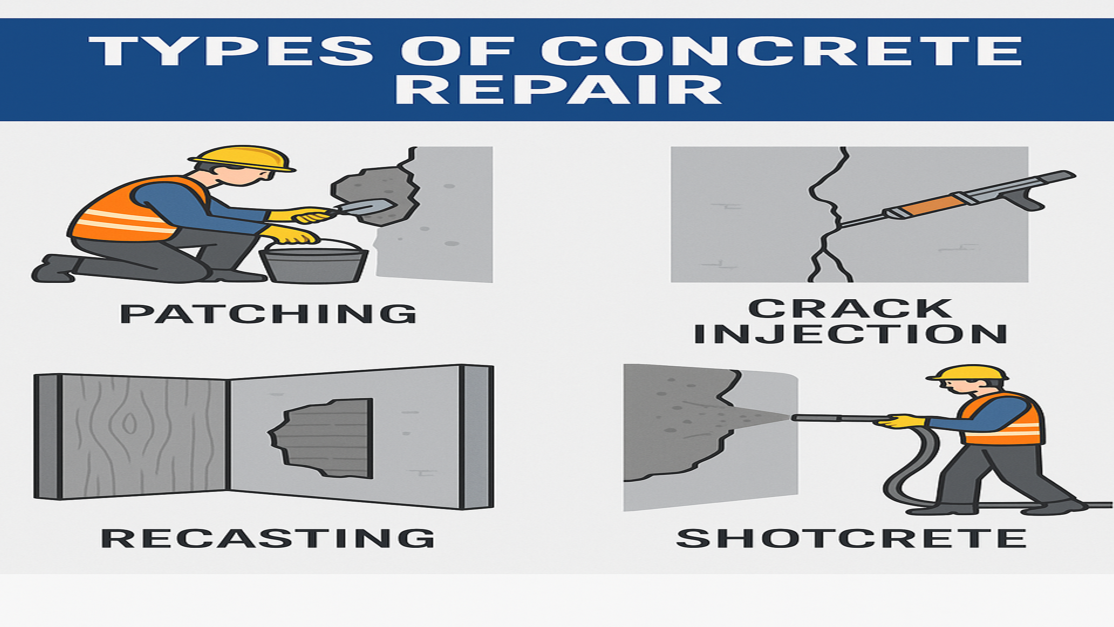
Concrete is one of the most widely used construction materials in civil engineering due to its high compressive strength, durability, and versatility. It is used in buildings, bridges, dams, tunnels, and pavements.
However, concrete structures do not last forever. Over time, environmental exposure, chemical reactions, construction defects, and structural loading may cause deterioration.
If deterioration is not detected and repaired early, it can lead to:
- Structural weakness
- Water leakage
- Reduced durability
- Costly reconstruction
- Structural collapse in extreme cases
Therefore, understanding causes of deterioration and rehabilitation methods is essential for structural engineers.


1. Corrosion of Reinforcement Steel
Reinforcement corrosion is considered the most common cause of concrete deterioration worldwide.
Concrete normally protects steel reinforcement because it is highly alkaline (pH around 12.5–13.5). This alkalinity forms a protective oxide layer on the steel surface.
However, when aggressive substances penetrate the concrete, this protective layer breaks down and corrosion begins.
Causes of Reinforcement Corrosion
• Carbonation
• Chloride penetration
• Poor concrete cover
• Cracks allowing moisture entry
• Poor quality concrete
Effects of Corrosion
- Expansion of rust (up to 6 times the steel volume)
- Cracking of concrete cover
- Spalling of concrete
- Reduction of structural capacity
Repair Technique – Cathodic Protection

Cathodic protection pier and platform

Cathodic protection on concrete corrosion prevention


Cathodic protection is one of the most effective methods used to stop reinforcement corrosion.
In this method, an electrical current is applied to the reinforcement so that it acts as a cathode, preventing oxidation.
Advantages
- Stops ongoing corrosion
- Extends structural life
- Suitable for marine and bridge structures
2. Carbonation of Concrete


Carbonation occurs when carbon dioxide from the atmosphere reacts with calcium hydroxide in concrete.
This chemical reaction forms calcium carbonate, which reduces the alkalinity of concrete.
When the pH of concrete drops below 9, reinforcement steel loses its protective layer and corrosion begins.
Factors Influencing Carbonation
- High permeability concrete
- Low cement content
- High water-cement ratio
- Thin concrete cover
- Humid environments
Identification
Engineers commonly use a Phenolphthalein indicator test.
If the concrete turns pink, it is still alkaline; if it remains colorless, carbonation has occurred.
Repair Technique – Surface Coatings & Sealers


Protective coatings prevent carbon dioxide, moisture, and chemicals from entering concrete.
Common coatings used in rehabilitation include:
- Epoxy coatings
- Polyurethane coatings
- Acrylic sealers
- Silane sealers
Benefits
- Reduces permeability
- Protects reinforcement
- Improves durability
3. Chloride Attack


Chloride ions penetrate concrete and destroy the protective oxide layer surrounding reinforcement steel.
Once the protective layer is destroyed, corrosion begins rapidly.
Common Sources
- Sea water
- De-icing salts
- Industrial chemicals
- Contaminated aggregates
Structures Most Affected
- Coastal buildings
- Marine structures
- Bridges
- Parking garages
Repair Technique – FRP Strengthening


Fiber Reinforced Polymer (FRP) systems are modern strengthening materials used to repair damaged concrete structures.
FRP sheets made of carbon fiber or glass fiber are bonded to structural elements.
Advantages
- Very high strength
- Lightweight
- Corrosion resistant
- Fast installation
Applications
- Bridge columns
- Beams
- Slabs
- Seismic retrofitting
4. Freeze-Thaw Damage


Freeze-thaw damage occurs when water inside concrete pores freezes and expands.
Water expands about 9% during freezing, which creates internal pressure.
Repeated freeze-thaw cycles cause:
- Surface scaling
- Cracking
- Loss of durability
- Reduction in strength
Repair Technique – Concrete Jacketing


Concrete jacketing is a strengthening technique where additional reinforcement and concrete are added around an existing structural member.
Benefits
- Increases load carrying capacity
- Improves durability
- Enhances earthquake resistance
Used For
- Columns
- Bridge piers
- Foundations
5. Alkali–Aggregate Reaction (AAR)

Alkali-Silica Reaction


Alkali–Aggregate Reaction occurs when alkalis in cement react with reactive silica in aggregates.
This reaction produces a gel-like substance that absorbs water and expands, causing internal stresses.
Symptoms
- Map cracking pattern
- Expansion of concrete
- Surface displacement
Repair Technique – Crack Injection

A concrete ceiling crack repair is underway using sealed epoxy and pressurized injection nipples to stop water ingress from below

Epoxy Injection Adhesive

Pressure pouring method used to repair concrete crack
Crack injection is widely used to repair structural cracks in concrete.
Epoxy or polyurethane resins are injected into cracks to restore structural integrity.
Advantages
- Restores structural strength
- Prevents water leakage
- Stops crack propagation
Inspection Methods for Concrete Deterioration
Before rehabilitation, engineers must identify the damage using inspection techniques.
Common methods include:
Visual Inspection
Detects cracks, rust stains, and spalling.
Rebound Hammer Test
Measures surface hardness of concrete.
Ultrasonic Pulse Velocity Test
Detects internal cracks and voids.
Half-Cell Potential Test
Determines probability of reinforcement corrosion.
Core Testing
Used to measure compressive strength and carbonation depth.
Importance of Concrete Rehabilitation
Concrete rehabilitation provides several benefits:
- Extends structural service life
- Reduces maintenance costs
- Improves safety
- Avoids demolition and reconstruction
- Enhances structural performance
Proper rehabilitation can increase the lifespan of structures by 30–50 years.
Conclusion
Concrete deterioration is unavoidable in long-term infrastructure due to environmental exposure and structural stresses. The most common causes include reinforcement corrosion, carbonation, chloride attack, freeze-thaw cycles, and alkali–aggregate reactions.
However, modern rehabilitation techniques such as crack injection, FRP strengthening, concrete jacketing, protective coatings, and cathodic protection can significantly extend the lifespan of concrete structures.
By combining proper inspection, early detection, and effective repair methods, engineers can ensure that structures remain safe, durable, and serviceable for decades.
Internal Linking Structure for Your Civil Engineering Website
To rank higher in Google, this article should link to other related posts on your website.
Recommended Internal Links
From this article → link to these topics
- Concrete Mix Design Guide
- Types of Cracks in Concrete Structures
- Reinforced Concrete Beam Design
- Concrete Durability and Protection Methods
- Non Destructive Testing of Concrete
- FRP Strengthening in Civil Engineering
- Bridge Rehabilitation Techniques
- Concrete Spalling Causes and Repair
- Structural Retrofitting Methods
- Concrete Construction Quality Control
- AISC Beam to Beam Bolted Shear Connection Calculator
 Structural steel beam connections are among the most critical elements… Read more: AISC Beam to Beam Bolted Shear Connection Calculator
 - Canadian Beam Design Calculator | Beam Load Calculator
 The Canadian Beam Design Calculator is a free online engineering… Read more: Canadian Beam Design Calculator | Beam Load Calculator
 - Australian Beam Design Calculator | Beam Load Calculator
 Australian Beam Design Calculator – Free Online Beam Load, Shear… Read more: Australian Beam Design Calculator | Beam Load Calculator
 - Beam to Column Shear Connection
 Introduction Beam-to-column shear connections are among the most frequently used… Read more: Beam to Column Shear Connection
 - Room Paint Calculator | Quantity and Cost Estimator
 Looking to renovate your room? Our Room Paint, Primer &… Read more: Room Paint Calculator | Quantity and Cost Estimator
 - Circular Pipe Base Plate Design | AISC ASD Guide + PDF Download
 Introduction The base plate is one of the most important… Read more: Circular Pipe Base Plate Design | AISC ASD Guide + PDF Download
 - Australian Wind Load Calculator as per AS/NZS 1170.2:2021
 Australian Wind Load Calculator | AS/NZS 1170.2:2021 Australian Wind Load… Read more: Australian Wind Load Calculator as per AS/NZS 1170.2:2021
 - Wind Load Calculator as per IS 875 Part 3:2015
 Industrial Shed Wind Load Calculator | IS 875 Part 3:2015… Read more: Wind Load Calculator as per IS 875 Part 3:2015
 - How to Assign LY and LZ in STAAD for Steel Structures (With and Without Bracing)
 🔹 What is LY and LZ? In STAAD.Pro: These define… Read more: How to Assign LY and LZ in STAAD for Steel Structures (With and Without Bracing)
 - Expansion, Contraction and Construction Joints in Concrete for Civil Works
 1. Introduction Concrete is one of the most widely used… Read more: Expansion, Contraction and Construction Joints in Concrete for Civil Works
 - Cable Rack Structural Steel Detail and Design
 Introduction Cable racks (also called cable trays or cable support… Read more: Cable Rack Structural Steel Detail and Design
 - Repair Principles for Corrosion Damaged Reinforced Concrete Structures
 Reinforced concrete is one of the most widely used construction… Read more: Repair Principles for Corrosion Damaged Reinforced Concrete Structures
 - Civil Engineering Guide to Concrete Repair and Strengthening
 Concrete is one of the most widely used construction materials… Read more: Civil Engineering Guide to Concrete Repair and Strengthening
 - Australian Code Load Combinations
 (For Steel Structures & RCC Buildings) 1. Relevant Australian Standards… Read more: Australian Code Load Combinations
 - Eurocode Base Plate Calculator – EN 1993-1-8
 Introduction Base plates are critical components in steel structures, transferring… Read more: Eurocode Base Plate Calculator – EN 1993-1-8
 - Base Plate Design Calculation AS 4100
 Introduction In structural steel design, the base plate is a… Read more: Base Plate Design Calculation AS 4100
 - Base Plate Design Calculator CSA A23.3
 Introduction Steel column base plates transfer loads from the column… Read more: Base Plate Design Calculator CSA A23.3
 - Base Plate Design Calculator ACI 318
 Introduction Designing a steel column base plate is a critical… Read more: Base Plate Design Calculator ACI 318
 - Base Plate Design as per IS 800 2007
 Introduction (Anchor Bolts Outside & Inside Column Flange) Base plates… Read more: Base Plate Design as per IS 800 2007
 - Bar Bending Schedule | BBS Calculator For Beam Column and Slab
 Managing the Bar Bending Schedule (BBS) is one of the… Read more: Bar Bending Schedule | BBS Calculator For Beam Column and Slab
 - Load Conversion & Stress Calculator | kN to kg, ton, N, MPa Online
 Load Conversion & Stress Calculator for Civil and Structural Engineers… Read more: Load Conversion & Stress Calculator | kN to kg, ton, N, MPa Online
 - Water Tank Capacity Calculator – Feet & Meter Conversion (Litres & Gallons)
 Water Tank Capacity Calculator with Unit Conversion Accurate water storage… Read more: Water Tank Capacity Calculator – Feet & Meter Conversion (Litres & Gallons)
 - Brick Wall Construction Calculator | Calculate Bricks & Cost Instantly |
 Introduction Building a brick wall requires accurate planning to avoid… Read more: Brick Wall Construction Calculator | Calculate Bricks & Cost Instantly |
 - Unit Converter – Feet, Inches, cm, mm, Yard to Meter and Vice Versa
 Length Unit Converter 🌙 Toggle Dark Mode Length Unit Converter… Read more: Unit Converter – Feet, Inches, cm, mm, Yard to Meter and Vice Versa
 - Lifting Analysis of Skid Using Spreader Beam 4-Point
 COG Shift, Moment Calculation & Sling Forces for STAAD Pro… Read more: Lifting Analysis of Skid Using Spreader Beam 4-Point