
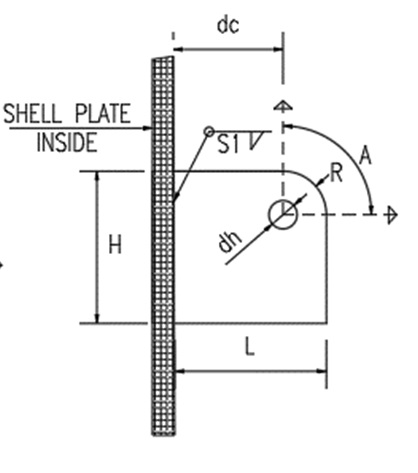
Padeye is a plate or attachment point commonly used in lifting and rigging operations to connect slings, shackles, or other lifting equipment. Proper design and calculation of a padeye are essential to ensure safe lifting operations. The calculation is based on factors such as load capacity, thickness of the plate, material properties, and hole size for the shackle.
Steps for Padeye Design and Calculation
- Load Determination:
- Design Load (P): Determine the load to be lifted, considering the dynamic factors. If a dynamic load factor (DLF) is required, multiply the static load by the DLF.
- Load Angles: Determine the loading angle (θ) and ensure that any out-of-plane loading is accounted for.
- Load Type: Consider whether the load is applied vertically or at an angle, which will impact the stresses on the padeye.
- Material Selection:
- Select an appropriate material for the padeye, such as steel (e.g., ASTM A36 or ASTM A572).
- Identify the material’s yield strength (fyf_yfy) and ultimate strength (fuf_ufu).
- Padeye Geometry:
- Thickness (t): Typically, the padeye plate thickness should be sufficient to resist the applied stresses. The thickness can be increased based on the load and the material’s strength.
- Hole Diameter (d_h): The hole should accommodate the shackle pin, with the diameter being slightly larger than the pin size.
- Padeye Length (L): The distance from the center of the hole to the edge of the padeye should be long enough to avoid tearing and stress concentration.
Padeye Width (W): The width of the padeye should be adequate to resist bending and shear stresses.

- Padeye Stress Calculation:
- a) Tension Stress:
The tensile stress (σt) on the padeye plate is calculated using: σt=P/ t×W
Where:
- P = Design load
- t = Padeye thickness
- W= Width of the padeye
Ensure that the tensile stress is less than the yield strength of the material (fy).
- b) Bearing Stress:
The bearing stress (σb) around the hole (where the shackle pin is placed) is: σb=P\dh×tP Where:
- P = Load applied
- dh = Hole diameter
- t = Thickness of the padeye plate
The bearing stress should be checked against the allowable bearing stress for the material.
- c) Shear Stress:
The shear stress (τ) on the padeye is calculated as: τ=P/ 2×t×W
Where:
- P = Applied load
- t = Thickness of the padeye plate
- W = Width of the padeye
Shear stress should be less than the allowable shear strength of the material, typically 0.6fy
- d) Bending Stress:
For a padeye subjected to bending due to out-of-plane loading or eccentric loading, the bending stress (σb ) can be calculated using: σb=M / S
Where:
- M = Bending moment
- S = Section modulus of the padeye cross-section
Ensure that the bending stress does not exceed the allowable stress of the material.
- Check Against Failure Modes:
- Tensile failure: Ensure that the tensile stress does not exceed the allowable tensile stress of the material.
- Bearing failure: Ensure that the bearing stress at the hole does not exceed the material’s bearing capacity.
- Shear failure: Check that the padeye can resist shear forces.
- Bending failure: If there is eccentric loading, check that the bending stresses are within safe limits.
- Tear-out failure: Ensure the distance from the hole to the edge of the plate is sufficient to prevent tear-out.
- Safety Factor:
Apply a safety factor to the design to account for uncertainties in load estimation, material strength, and fabrication quality. A common safety factor for padeyes is 1.5 to 3, depending on the application.
- Weld Strength (if applicable):
If the padeye is welded to a structure, ensure that the welds are designed to handle the applied loads. Check both the throat size and the length of the weld.
Conclusion:
The design of a padeye requires careful consideration of material strength, geometry, and load application. The stresses (tensile, shear, and bearing) must be checked, and the design must meet the required safety factors. Accurate calculation ensures the padeye can handle the lifting operation without failure.
Example Calculation:
- Load (P): = 50 kN
- Material: Steel with yield strength fy= 250 Mpa
- Padeye thickness (t): = 20 mm
- Hole diameter (d_h): = 25 mm
- Padeye width (W): = 100 mm
- Tension Stress:
σt = 50,000 / 20×100 =25 MPa
(Tensile stress is less than fy).
- Bearing Stress:
σb =50,000 / 25×20 =100 MPa
(Check against allowable bearing stress).
- Shear Stress:
τ = 50,000 / 2×20×100=12.5 MPa
(Shear stress is within limits).
By following these steps and performing necessary calculations, the Padeye design will ensure safe and efficient lifting operations

Categories
- 3D HOUSE DESIGN (42)
- Auto Calculator – Civil & Structural Engineering Calculation Tools (14)
- Civil and Structural Design Calculations (89)
- Commercial Plans (9)
- East Facing House Plans (16)
- Engineering Concepts – Civil & Structural (265)
- Excel Spreadsheets (37)
- Free Downloads (55)
- House Plans (65)
- Industrial standards (113)
- North Facing House Plans (16)
- South Facing House Plans (16)
- West Facing House Plans (14)
Recent Posts
- AISC Beam to Beam Bolted Shear Connection Calculator
- Canadian Beam Design Calculator | Beam Load Calculator
- Australian Beam Design Calculator | Beam Load Calculator
- Beam to Column Shear Connection
- House Plan 30 × 28 West Facing | Ground Floor + First Floor + Second Floor | 3BHK Modern Home Design
- Pile Cap Detail Drawing Free Download
- Splice Details for Angles
- Mordern Floor Tile Design 50+
- Room Paint Calculator | Quantity and Cost Estimator
- Manhole Cover Detail
- Commercial House Plan with 2 Shops | East Facing
- Circular Pipe Base Plate Design | AISC ASD Guide + PDF Download
- Side Cladding Runner Details for PEB Structures
- Expansion Joints in Concrete Pavements
- Australian Wind Load Calculator as per AS/NZS 1170.2:2021
- Wind Load Calculator as per IS 875 Part 3:2015
- RCC Staircase Detail Drawing free pdf Download
- Modern 35×40 House Design with Premium Front Elevation
- Pipe Rack GA Drawing Layout
- House Plan 30×40 West Facing | 2BHK Luxury Floor Design |
- Bund Wall Detail Drawing for Tank Farm and Oil Storage Area
- Dyke Wall Layout and Detail | Oil Tank Containment Systems |
- Apartment Plan 28×32 West Facing with Modern Elevation
- How to Assign LY and LZ in STAAD for Steel Structures (With and Without Bracing)
- HOUSE PLAN 35 X 41 | EAST FACING |
- EDG Building Power Cable Layout with MTO Guide
- Septic Tank Drawing and Details
- Holding Tank Detail
- Rain Water Harvesting System pdf Book Download
- Galvanized Gate | Design Details and Specifications Guide |
- Soak Pit Details | Seepage Pit |
- HOUSE PLAN 25 X 48 | SOUTH FACING |
- Expansion, Contraction and Construction Joints in Concrete for Civil Works
- Modern 4BHK West Facing House Plan (60×50) with Pool & Luxury 3D Design
- Cable Rack Structural Steel Detail and Design
- RCC Shear Wall Details
- RCC Column with Splice and Coupler in Reinforcement Free Download
- Repair Principles for Corrosion Damaged Reinforced Concrete Structures
- Civil Engineering Guide to Concrete Repair and Strengthening
- Australian Code Load Combinations
- Modular Kitchen | Kitchen Cabinet Design Ideas with Cost |
- Bathroom Design Ideas for Modern Homes
- Manhole Types and Details
- Catch Basin Types and Details
- Eurocode Base Plate Calculator – EN 1993-1-8
- Base Plate Design Calculation AS 4100
- Base Plate Design Calculator CSA A23.3
- Base Plate Design Calculator ACI 318
- Base Plate Design as per IS 800 2007
- East Facing 38×56 House Plan – Ground & First Floor Design with 3BHK + Home Theatre