
Introduction
Reinforced Cement Concrete (RCC) columns are one of the most important structural components in buildings. They transfer loads from beams and slabs to the foundation safely. Proper reinforcement detailing is essential to ensure strength, durability, and stability of the column.
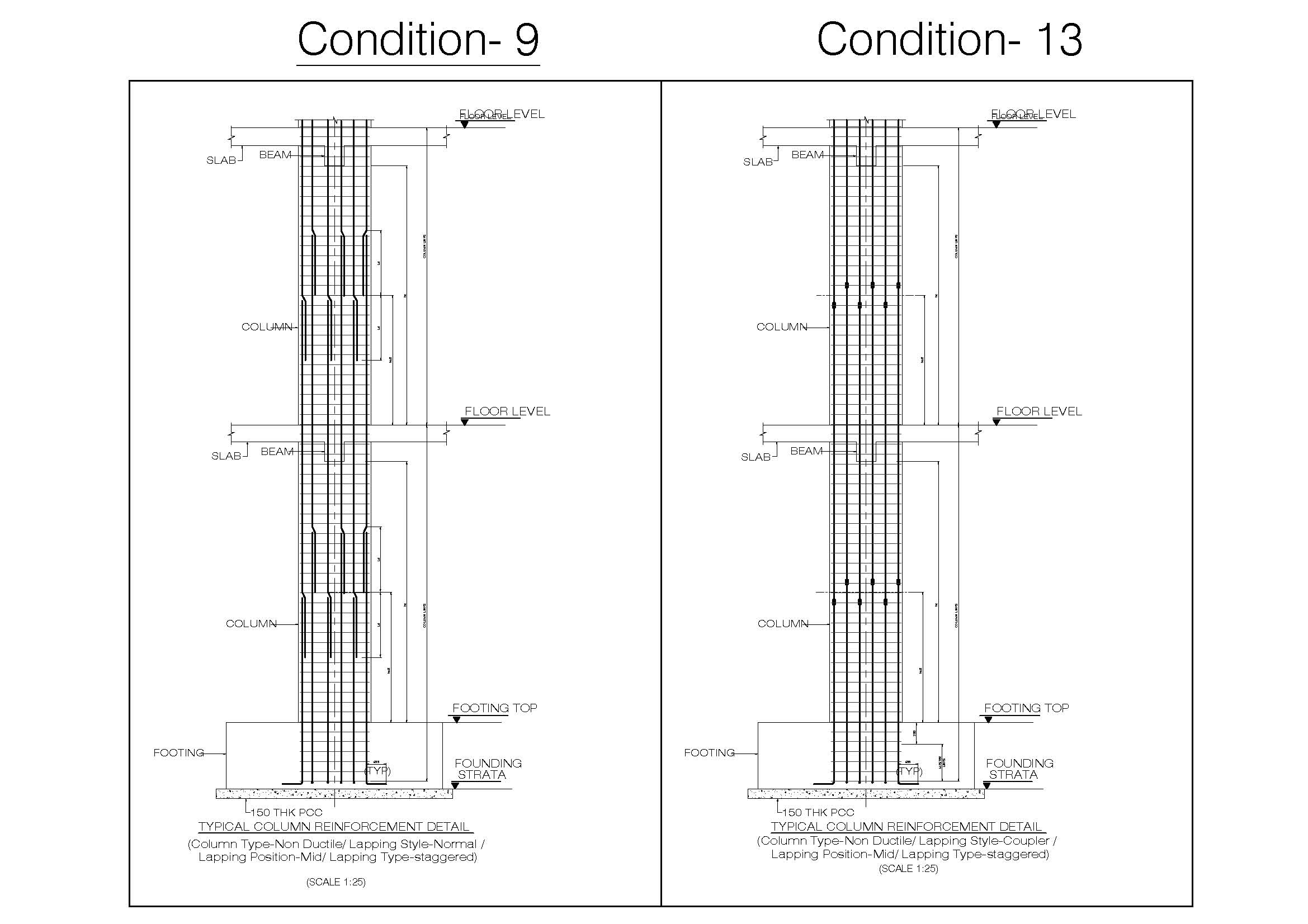
In RCC column construction, reinforcement bars are often connected using lap splices or mechanical couplers. These connections allow continuity of reinforcement when bar lengths are limited or when structural loads require extended reinforcement.


This article explains RCC column section details, reinforcement arrangement, lap splicing, and coupler connections used in modern structural construction.
1. RCC Column Section Details


The column section shows the internal arrangement of reinforcement bars and ties inside the concrete.
Main Components of an RCC Column Section
Click below Free download Editable file
1. Longitudinal Reinforcement
These are vertical steel bars placed along the height of the column.
Functions:
- Carry axial compressive loads
- Resist bending moments
- Improve ductility of the column
Typical details:
- Minimum bars: 4 bars for rectangular column
- Minimum bars: 6 bars for circular column
- Bar diameter: 12 mm – 32 mm
- Steel grade: Fe415 / Fe500
Example:
- 300 mm × 450 mm column
- 8 bars of 16 mm diameter
2. Lateral Reinforcement (Stirrups or Ties)
Stirrups hold the longitudinal bars in position and provide confinement to concrete.
Functions:
- Prevent buckling of vertical bars
- Provide shear resistance
- Improve column ductility
Typical details:
- Stirrup diameter: 8 mm or 10 mm
- Spacing: 100 mm – 300 mm
Closer spacing is provided near beam-column joints.
3. Concrete Cover
Concrete cover protects steel from corrosion and fire.
Typical cover values:
- Interior column: 40 mm
- Exterior column: 50 mm
- Columns exposed to soil: 75 mm
2. Lap Splice in RCC Columns


Lap splicing is the traditional method used to connect two reinforcement bars by overlapping them.
Why Lap Splice is Required
Steel bars available in market usually come in 12 meter lengths. When the column height exceeds this length, bars must be joined.
Lap splice ensures that forces transfer from one bar to another safely.
Lap Length for Columns
The lap length depends on:
- Bar diameter
- Grade of concrete
- Grade of steel
- Stress conditions
Typical lap length:
Compression lap length = 40 × bar diameter
Example:
16 mm bar lap length:
40 × 16 = 640 mm
So overlap should be minimum 640 mm.
Important Lap Splice Rules
- Lap should not be provided at beam-column joint
- Laps should be staggered
- Maximum 50% bars lapped at one section
- Provide closer stirrup spacing in lap zone
Example stirrup spacing:
- 100 mm spacing in splice zone
3. Mechanical Couplers in RCC Columns


Mechanical couplers are modern devices used to connect reinforcement bars without overlapping.
A coupler is a steel sleeve that connects two reinforcement bars by threading or locking mechanism.
Couplers are becoming popular in high-rise buildings, bridges, and metro structures.
Types of Rebar Couplers
1. Threaded Coupler
Bars are threaded and connected using a sleeve.
Advantages:
- Strong connection
- High load transfer
- Widely used in high-rise buildings
2. Grout Coupler
Bars are inserted into sleeve and grout is injected.
Used mainly in precast construction.
3. Swaged Coupler
Sleeve is compressed around reinforcement bars using hydraulic equipment.
4. Advantages of Using Couplers Instead of Lap Splice
| Feature | Lap Splice | Coupler |
|---|---|---|
| Steel Consumption | High | Reduced |
| Congestion | High | Low |
| Structural Strength | Moderate | High |
| Suitable for High Rise | Limited | Excellent |
| Concrete Compaction | Difficult | Easy |
Couplers reduce reinforcement congestion, especially in columns where many bars meet.
5. Typical RCC Column Reinforcement Detail
Example structural column:
Column size: 300 mm × 450 mm
Reinforcement:
- 8 bars – 20 mm diameter
- 8 mm stirrups @ 150 mm c/c
- 8 mm stirrups @ 100 mm c/c in lap zone
- Concrete grade: M30
- Steel grade: Fe500
Splice method:
- Lap splice length: 800 mm
OR - Mechanical coupler connection
6. Construction Steps for Column Reinforcement
- Fix vertical reinforcement bars according to structural drawing
- Provide stirrups at specified spacing
- Install lap splice or couplers
- Check alignment and verticality
- Provide proper cover blocks
- Install column formwork
- Pour concrete and compact properly
Quality checks ensure that reinforcement remains in correct position during concreting.
7. Common Mistakes in Column Reinforcement
Avoid these mistakes during construction:
❌ Providing lap splice at beam column joint
❌ Too many bars lapped at same location
❌ Insufficient stirrups in splice zone
❌ Improper coupler tightening
❌ Lack of concrete cover
These mistakes can reduce structural safety.
Conclusion
RCC columns are critical structural elements that carry loads from the entire building. Proper reinforcement detailing including column section arrangement, lap splicing, and mechanical couplers ensures safe load transfer and structural stability.
While lap splicing is a traditional method, mechanical couplers are becoming increasingly popular in modern construction because they reduce steel congestion and improve structural performance.
Following correct reinforcement detailing standards ensures that RCC columns remain strong, durable, and safe for the life of the structure.