
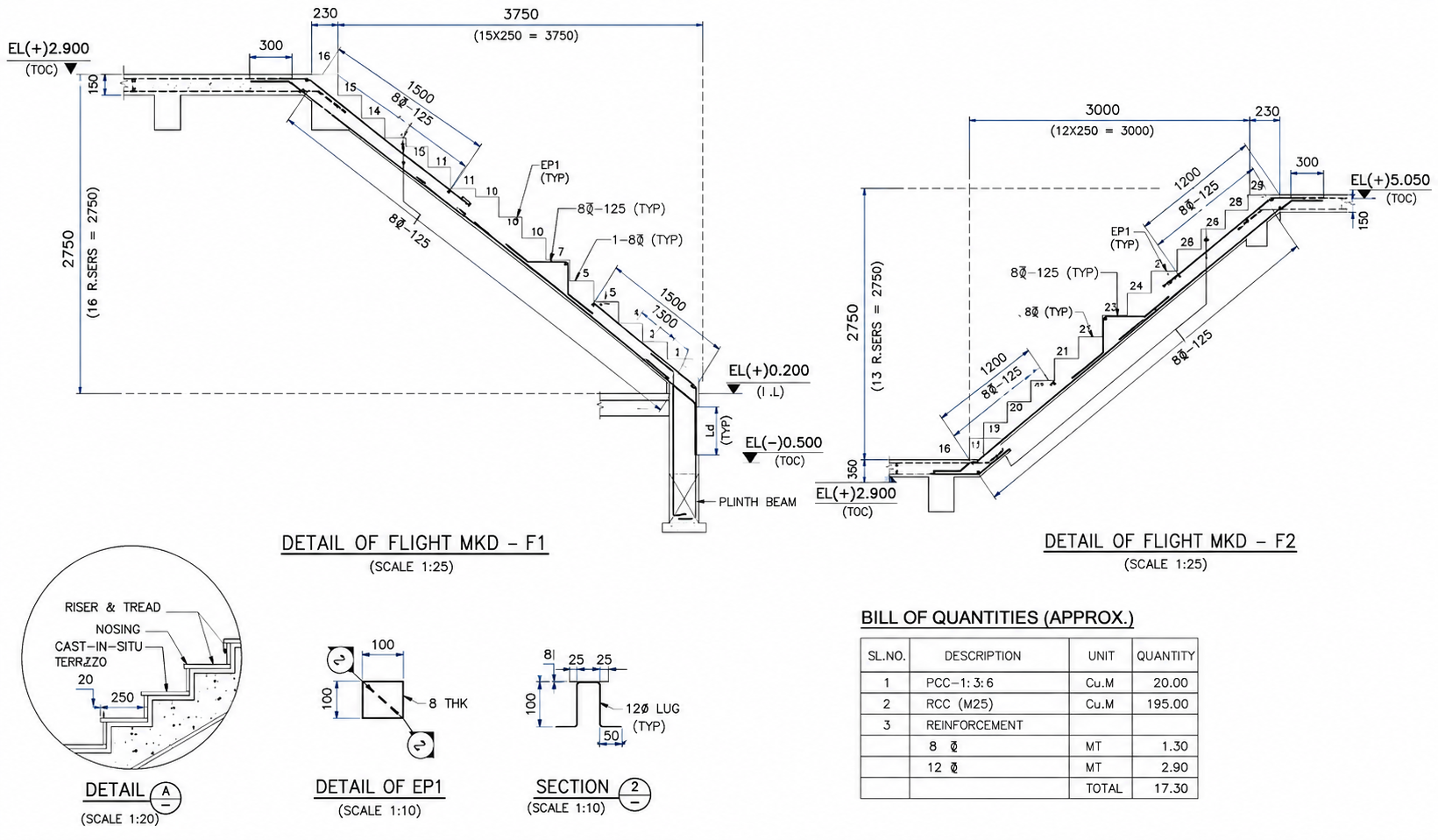
Reinforced Cement Concrete (RCC) staircases are one of the most important structural elements in residential, commercial, and industrial buildings. Proper detailing of the riser, tread, waist slab, reinforcement bars, landing beam connection, and support details ensures safety, durability, and comfortable movement between floors.
This article explains complete RCC staircase detail drawings including riser and tread dimensions, reinforcement arrangement, construction sequence, and practical site execution methods.
What is Riser and Tread in RCC Staircase?
Riser
The vertical portion between two steps is called the riser.
- Standard riser height:
- Residential: 150 mm to 175 mm
- Commercial: 120 mm to 150 mm
A higher riser makes climbing difficult, while a lower riser increases staircase length.


Tread
The horizontal surface where the foot is placed is called the tread.
- Standard tread width:
- Residential: 250 mm to 300 mm
- Commercial: 300 mm to 350 mm
A wider tread provides better walking comfort and safety.
Standard RCC Staircase Dimensions
| Component | Recommended Size |
|---|---|
| Riser Height | 150–175 mm |
| Tread Width | 250–300 mm |
| Waist Slab Thickness | 120–180 mm |
| Landing Thickness | 120–150 mm |
| Stair Width | 900–1500 mm |
| Handrail Height | 900 mm |
RCC Staircase Components
1. Waist Slab
The inclined RCC slab carrying the staircase load.
Functions:
- Transfers load to beams and columns
- Supports step concrete
- Holds reinforcement bars
Typical thickness:
- 120 mm to 180 mm

2. Steps (Riser & Tread)
Steps are constructed over the waist slab.
Construction Types:
- Brick-filled steps with concrete finish
- Fully RCC cast monolithic steps
- Precast RCC steps
3. Landing
Landing is the horizontal resting platform between stair flights.
Purpose:
- Provides rest area
- Changes stair direction
- Improves safety
4. Reinforcement Steel
Steel bars resist tension forces in the staircase slab.
Common Reinforcement:
- Main bars along slope
- Distribution bars perpendicular to slope
- Extra top bars at supports
- Landing beam anchorage bars
RCC Staircase Detail Drawing Explanation
Longitudinal Section Details
A staircase sectional drawing generally includes:
- Floor-to-floor height
- Number of risers
- Tread dimensions
- Waist slab thickness
- Reinforcement spacing
- Landing level
- Beam connection details
Typical Reinforcement Details
Main Bars
- Usually 10 mm or 12 mm bars
- Spacing: 100 mm to 150 mm c/c
- Provided along staircase slope
Distribution Bars
- Usually 8 mm bars
- Spacing: 150 mm to 200 mm c/c
- Placed perpendicular to main bars
Cover
Concrete cover protects reinforcement from corrosion.
Typical cover:
- 20 mm to 25 mm
Staircase Slope Calculation
Ideal staircase slope:
- Between 25° and 40°
Formula:
2R + T = 600 mm to 650 mm
Where:
- R = Riser
- T = Tread
Example:
- Riser = 160 mm
- Tread = 280 mm
2(160) + 280 = 600 mm
This provides comfortable stair movement.
Types of RCC Staircases
Dog Legged Staircase
Most commonly used in residential buildings.
Features:
- Two parallel flights
- Intermediate landing
- Space-saving design
Open Well Staircase
Contains open space between flights.
Advantages:
- Better appearance
- Good ventilation
Cantilever Staircase
Steps project from wall without visible support.
Used In:
- Modern architecture
- Luxury interiors
Spiral RCC Staircase
Circular staircase around central column.
Suitable For:
- Compact areas
- Terrace access
RCC Staircase Construction Procedure
Step 1 – Layout Marking
- Mark staircase dimensions
- Check floor height
- Calculate riser count
Step 2 – Centering and Shuttering
- Install plywood and steel supports
- Provide inclined shuttering
- Ensure proper alignment
Step 3 – Reinforcement Fixing
- Place main and distribution bars
- Provide cover blocks
- Fix landing reinforcement
Step 4 – Electrical Conduit Provision
- Install conduit for stair lighting if required
Step 5 – Concrete Pouring
- Use M20 or higher grade concrete
- Compact using vibrator
- Avoid honeycombing
Step 6 – Curing
- Cure minimum 7–14 days
- Maintain moisture continuously
Common Site Mistakes in RCC Staircase
Incorrect Riser Height
Uneven risers create walking discomfort and safety hazards.
Improper Reinforcement Anchorage
Insufficient anchorage weakens staircase support.
Poor Shuttering Alignment
Causes uneven steps and finishing defects.
Insufficient Concrete Cover
Leads to reinforcement corrosion.
Honeycombing in Waist Slab
Occurs due to poor vibration during concreting.
Advantages of RCC Staircase
- High strength and durability
- Fire resistant
- Low maintenance
- Suitable for heavy loads
- Long service life
- Economical for multi-storey buildings
RCC Staircase Design Tips
- Maintain uniform riser height
- Avoid steep stair slope
- Provide anti-skid finish
- Ensure proper headroom
- Use adequate reinforcement
- Follow IS 456 and IS 875 standards
Conclusion
Proper RCC staircase riser and tread detailing is essential for structural safety, user comfort, and long-term durability. Accurate reinforcement placement, correct riser-tread proportion, and proper shuttering practices ensure a high-quality staircase structure.
Whether for residential houses, apartments, commercial buildings, or industrial facilities, understanding RCC staircase detail drawings helps engineers, contractors, and homeowners achieve safe and efficient construction.
- House Plan 30 × 28 West Facing | Ground Floor + First Floor + Second Floor | 3BHK Modern Home Design
 If you are searching for a compact yet luxurious West… Read more: House Plan 30 × 28 West Facing | Ground Floor + First Floor + Second Floor | 3BHK Modern Home Design
 - Pile Cap Detail Drawing Free Download
 Pile caps are one of the most important components in… Read more: Pile Cap Detail Drawing Free Download
 - Splice Details for Angles
 Steel angle sections are one of the most commonly used… Read more: Splice Details for Angles
 - Mordern Floor Tile Design 50+
 Floor Tile Design Ideas – Elevate Your Spaces with Style… Read more: Mordern Floor Tile Design 50+
 - Room Paint Calculator | Quantity and Cost Estimator
 Looking to renovate your room? Our Room Paint, Primer &… Read more: Room Paint Calculator | Quantity and Cost Estimator
 - Manhole Cover Detail
 Manhole covers are one of the most important components in… Read more: Manhole Cover Detail
 - Commercial House Plan with 2 Shops | East Facing
 Looking for a modern commercial-cum-residential building plan that generates rental… Read more: Commercial House Plan with 2 Shops | East Facing
 - Circular Pipe Base Plate Design | AISC ASD Guide + PDF Download
 Introduction The base plate is one of the most important… Read more: Circular Pipe Base Plate Design | AISC ASD Guide + PDF Download
 - Side Cladding Runner Details for PEB Structures
 Introduction Side cladding runners are one of the most important… Read more: Side Cladding Runner Details for PEB Structures
 - Expansion Joints in Concrete Pavements
 Concrete pavements are designed to withstand heavy traffic loads, temperature… Read more: Expansion Joints in Concrete Pavements
 - Australian Wind Load Calculator as per AS/NZS 1170.2:2021
 Australian Wind Load Calculator | AS/NZS 1170.2:2021 Australian Wind Load… Read more: Australian Wind Load Calculator as per AS/NZS 1170.2:2021
 - Wind Load Calculator as per IS 875 Part 3:2015
 Industrial Shed Wind Load Calculator | IS 875 Part 3:2015… Read more: Wind Load Calculator as per IS 875 Part 3:2015
 - RCC Staircase Detail Drawing free pdf Download
 Reinforced Cement Concrete (RCC) staircases are one of the most… Read more: RCC Staircase Detail Drawing free pdf Download
 - Modern 35×40 House Design with Premium Front Elevation
 Building a dream home on a 35×40 plot is one… Read more: Modern 35×40 House Design with Premium Front Elevation
 - Pipe Rack GA Drawing Layout
 Image – Typical Pipe Rack GA Drawing Explanation The above… Read more: Pipe Rack GA Drawing Layout
 - House Plan 30×40 West Facing | 2BHK Luxury Floor Design |
 Designing a compact yet spacious home on a 30×40 plot… Read more: House Plan 30×40 West Facing | 2BHK Luxury Floor Design |
 - Bund Wall Detail Drawing for Tank Farm and Oil Storage Area
 Introduction A bund wall (also called a dyke wall or… Read more: Bund Wall Detail Drawing for Tank Farm and Oil Storage Area
 - Dyke Wall Layout and Detail | Oil Tank Containment Systems |
 Introduction A dyke wall (also called a bund wall or… Read more: Dyke Wall Layout and Detail | Oil Tank Containment Systems |
 - Apartment Plan 28×32 West Facing with Modern Elevation
 This project showcases a well-planned 30×40 west-facing apartment design featuring… Read more: Apartment Plan 28×32 West Facing with Modern Elevation
 - How to Assign LY and LZ in STAAD for Steel Structures (With and Without Bracing)
 🔹 What is LY and LZ? In STAAD.Pro: These define… Read more: How to Assign LY and LZ in STAAD for Steel Structures (With and Without Bracing)
 - HOUSE PLAN 35 X 41 | EAST FACING |
 Designing a perfect home requires a balance of functionality, aesthetics,… Read more: HOUSE PLAN 35 X 41 | EAST FACING |
 - EDG Building Power Cable Layout with MTO Guide
 Introduction An Emergency Diesel Generator (EDG) system is a critical… Read more: EDG Building Power Cable Layout with MTO Guide
 - Septic Tank Drawing and Details
 Septic tanks are widely used in residential buildings for on-site… Read more: Septic Tank Drawing and Details
 - Holding Tank Detail
 Introduction A holding tank, also known as a water sump… Read more: Holding Tank Detail
 - Rain Water Harvesting System pdf Book Download
 TABLE OF CONTENTS 1.0 INTRODUCTION 3 2.0 CHAPTER 1 4… Read more: Rain Water Harvesting System pdf Book Download