
Introduction
A bund wall (also called a dyke wall or containment wall) is an engineered earth or concrete embankment constructed around storage tanks, chemical plants, oil facilities, transformer yards, and hazardous liquid storage areas. The primary purpose of a bund wall is to contain accidental leakage or spills and prevent environmental contamination.
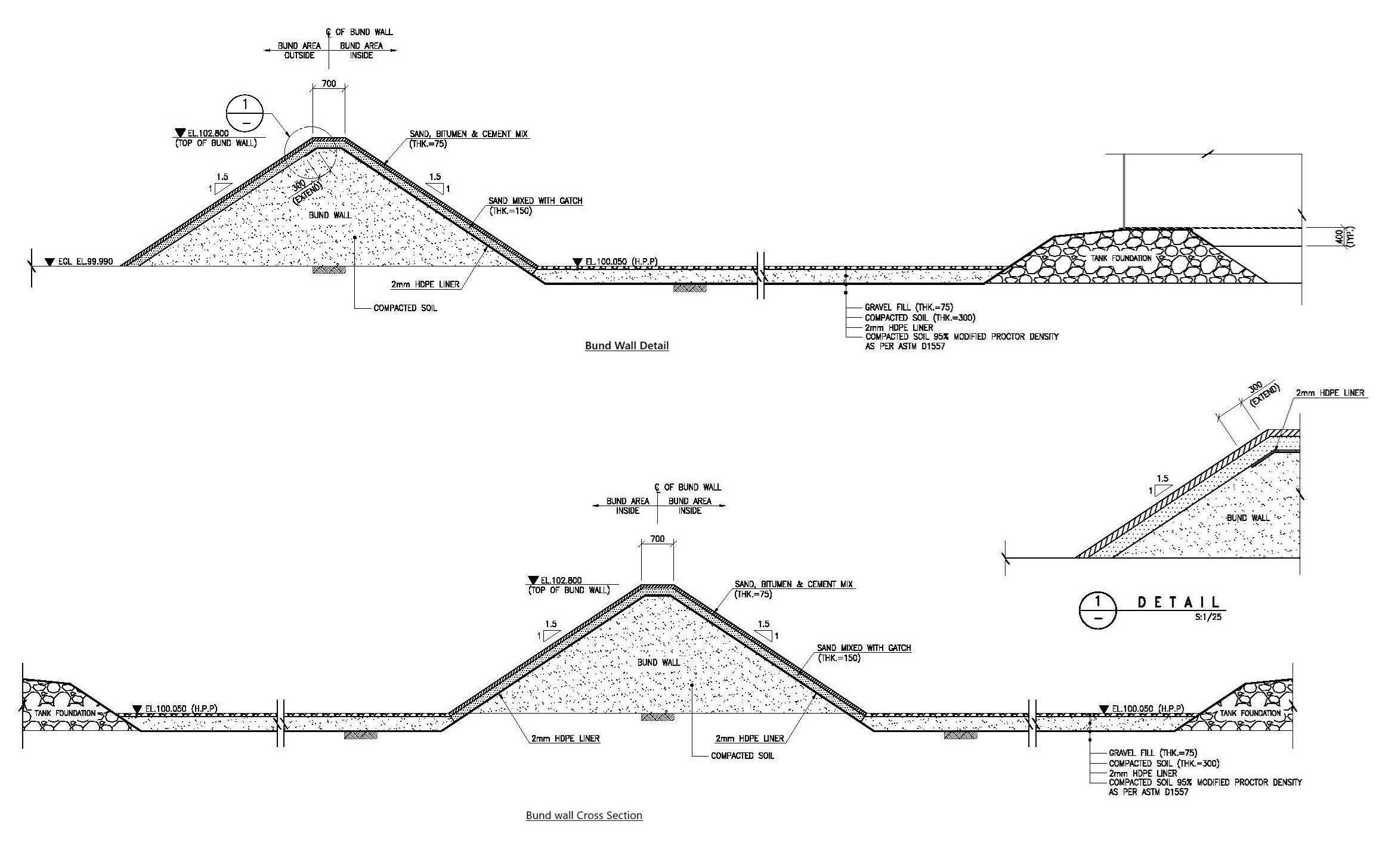
The above drawing shows a typical bund wall cross section with:
- Compacted earth embankment
- HDPE liner protection
- Sand-bitumen-cement protective layer
- Tank foundation
- Gravel fill
- Pipe crossing arrangement
This article explains the complete bund wall construction methodology, section details, materials, dimensions, and engineering considerations.


What is a Bund Wall?
A bund wall is a protective retaining embankment constructed around tanks or hazardous liquid storage areas to:
- Contain oil or chemical leakage
- Prevent groundwater contamination
- Protect nearby structures
- Reduce fire spreading risk
- Meet environmental and safety regulations

Bund walls are commonly used in:
- Oil storage terminals
- Petroleum plants
- Chemical industries
- Transformer yards
- Diesel generator areas
- Fuel storage farms
- Water treatment plants
Main Components of Bund Wall
1. Compacted Soil Embankment
The main body of the bund wall is constructed using selected compacted earth fill.
Features:
- Provides structural stability
- Forms containment area
- Supports liner system
Typical Requirements:
- Compaction: 95% Modified Proctor Density
- Layer thickness: 200–300 mm
- Side slope: 1.5H : 1V
- Top width: Usually 700 mm minimum
2. HDPE Liner
A 2 mm HDPE liner is provided to prevent seepage of oil or chemicals into the ground.
Purpose:
- Chemical resistance
- Waterproofing
- Leak containment
- Soil protection
Advantages:
- Long life
- UV resistant
- Excellent impermeability
- Easy installation
Typical Thickness:
- 1.5 mm to 2 mm
In this drawing:
- 2 mm HDPE liner is used over compacted soil.
3. Sand, Bitumen & Cement Protective Layer
A protective surface layer is provided above the liner.
Thickness:
- Approximately 75 mm
Purpose:
- Protects HDPE liner from damage
- Improves erosion resistance
- Increases durability
Composition:
- Sand
- Bitumen
- Cement mix
This layer acts as a protective skin over the bund slope.
4. Sand Mixed with Gatch Layer
A sand-gatch layer is provided along the slope.
Thickness:
- Around 150 mm
Function:
- Surface stabilization
- Slope protection
- Improves drainage characteristics
5. Gravel Fill
Gravel fill is provided near the tank foundation area.
Purpose:
- Load distribution
- Drainage improvement
- Foundation stability
Typical Thickness:
- 75 mm
6. Tank Foundation
The tank foundation supports the oil or chemical storage tank.
Common Foundation Types:
- Ring wall foundation
- Stone pitching foundation
- RCC ring foundation
Requirements:
- Uniform settlement control
- Proper load transfer
- Stable compacted base
Bund Wall Cross Section Details
Typical Dimensions
| Item | Typical Value |
|---|---|
| Top Width | 700 mm |
| Side Slope | 1.5 : 1 |
| HDPE Thickness | 2 mm |
| Protective Layer | 75 mm |
| Sand-Gatch Layer | 150 mm |
| Compaction | 95% MDD |
| Gravel Fill | 75 mm |
Bund Wall Construction Procedure
Step 1 – Site Preparation
- Clear vegetation and debris
- Mark bund alignment
- Prepare formation level
Step 2 – Earthwork Filling
- Place selected soil in layers
- Compact each layer properly
- Maintain required moisture content
Important:
Improper compaction may cause:
- Settlement
- Cracking
- Liner failure
Step 3 – Bund Shaping
The embankment is shaped according to design slopes.
Typical Slope:
1.5 Horizontal : 1 Vertical
Proper slope ensures:
- Stability
- Reduced erosion
- Better liner placement
Step 4 – HDPE Liner Installation
Procedure:
- Surface cleaning
- Remove sharp particles
- Spread liner sheets
- Weld joints using hot wedge welding
- Test welded seams
Precautions:
- Avoid wrinkles
- Prevent puncture
- Protect from sharp stones
Step 5 – Protective Layer Application
Apply:
- Sand-bitumen-cement mix
- Sand-gatch protective layer
This protects liner from:
- UV exposure
- Mechanical damage
- Weather effects
Step 6 – Foundation & Gravel Work
- Construct tank foundation
- Place gravel fill
- Compact surrounding area
Importance of Bund Wall in Industrial Safety
Bund walls are extremely important because they:
- Prevent hazardous spills
- Protect nearby structures
- Reduce environmental pollution
- Improve fire safety
- Ensure statutory compliance
Design Considerations
1. Storage Capacity
Bund capacity should generally be:
- 110% of largest tank capacity
2. Soil Condition
Weak soil may require:
- Soil stabilization
- Geotextile reinforcement
- RCC retaining system
3. Seepage Protection
HDPE liners are mandatory in:
- Oil storage areas
- Chemical zones
- Hazardous liquid facilities
4. Rainwater Drainage
Provide:
- Drain valves
- Sump pits
- Oil-water separators
Common Bund Wall Failures
1. Poor Compaction
Causes settlement and cracking.
2. Liner Damage
Sharp stones may puncture HDPE liner.
3. Erosion
Improper slope protection leads to erosion.
4. Water Accumulation
Lack of drainage causes instability.
Advantages of HDPE Bund Wall System
- Excellent leak protection
- Long service life
- Low maintenance
- High chemical resistance
- Environmentally safe
- Economical construction
Recommended Quality Checks
Earthwork
- Density test
- Moisture content test
HDPE Liner
- Spark test
- Vacuum test
- Seam weld inspection
Surface Layer
- Thickness checking
- Crack inspection
Applications of Bund Walls
Bund walls are widely used in:
- Oil depots
- Petrochemical plants
- Fuel stations
- Power plants
- Tank farms
- Chemical storage yards
- Transformer oil pits
Conclusion
A properly designed bund wall system is critical for industrial safety and environmental protection. The combination of:
- Compacted earth bund
- HDPE liner
- Protective layers
- Proper foundation system
ensures long-term containment performance and durability.
The cross section shown above represents a standard industrial bund wall arrangement suitable for oil storage and hazardous liquid containment applications. Proper construction practices, compaction, and liner installation are essential for achieving leak-proof and stable bund structures.
- Beam to Column Shear Connection
 Introduction Beam-to-column shear connections are among the most frequently used… Read more: Beam to Column Shear Connection
 - Pile Cap Detail Drawing Free Download
 Pile caps are one of the most important components in… Read more: Pile Cap Detail Drawing Free Download
 - Splice Details for Angles
 Steel angle sections are one of the most commonly used… Read more: Splice Details for Angles
 - Room Paint Calculator | Quantity and Cost Estimator
 Looking to renovate your room? Our Room Paint, Primer &… Read more: Room Paint Calculator | Quantity and Cost Estimator
 - Manhole Cover Detail
 Manhole covers are one of the most important components in… Read more: Manhole Cover Detail
 - Side Cladding Runner Details for PEB Structures
 Introduction Side cladding runners are one of the most important… Read more: Side Cladding Runner Details for PEB Structures
 - Expansion Joints in Concrete Pavements
 Concrete pavements are designed to withstand heavy traffic loads, temperature… Read more: Expansion Joints in Concrete Pavements
 - RCC Staircase Detail Drawing free pdf Download
 Reinforced Cement Concrete (RCC) staircases are one of the most… Read more: RCC Staircase Detail Drawing free pdf Download
 - Pipe Rack GA Drawing Layout
 Image – Typical Pipe Rack GA Drawing Explanation The above… Read more: Pipe Rack GA Drawing Layout
 - Bund Wall Detail Drawing for Tank Farm and Oil Storage Area
 Introduction A bund wall (also called a dyke wall or… Read more: Bund Wall Detail Drawing for Tank Farm and Oil Storage Area
 - Dyke Wall Layout and Detail | Oil Tank Containment Systems |
 Introduction A dyke wall (also called a bund wall or… Read more: Dyke Wall Layout and Detail | Oil Tank Containment Systems |
 - How to Assign LY and LZ in STAAD for Steel Structures (With and Without Bracing)
 🔹 What is LY and LZ? In STAAD.Pro: These define… Read more: How to Assign LY and LZ in STAAD for Steel Structures (With and Without Bracing)
 - EDG Building Power Cable Layout with MTO Guide
 Introduction An Emergency Diesel Generator (EDG) system is a critical… Read more: EDG Building Power Cable Layout with MTO Guide
 - Septic Tank Drawing and Details
 Septic tanks are widely used in residential buildings for on-site… Read more: Septic Tank Drawing and Details
 - Holding Tank Detail
 Introduction A holding tank, also known as a water sump… Read more: Holding Tank Detail
 - Rain Water Harvesting System pdf Book Download
 TABLE OF CONTENTS 1.0 INTRODUCTION 3 2.0 CHAPTER 1 4… Read more: Rain Water Harvesting System pdf Book Download
 - Galvanized Gate | Design Details and Specifications Guide |
 Introduction Industrial galvanized gates are designed for heavy-duty usage, high… Read more: Galvanized Gate | Design Details and Specifications Guide |
 - Soak Pit Details | Seepage Pit |
 Introduction A soak pit or seepage pit (also called a… Read more: Soak Pit Details | Seepage Pit |
 - Expansion, Contraction and Construction Joints in Concrete for Civil Works
 1. Introduction Concrete is one of the most widely used… Read more: Expansion, Contraction and Construction Joints in Concrete for Civil Works
 - Cable Rack Structural Steel Detail and Design
 Introduction Cable racks (also called cable trays or cable support… Read more: Cable Rack Structural Steel Detail and Design
 - RCC Shear Wall Details
 Introduction Reinforced Cement Concrete (RCC) shear walls are one of… Read more: RCC Shear Wall Details
 - RCC Column with Splice and Coupler in Reinforcement Free Download
 Introduction Reinforced Cement Concrete (RCC) columns are one of the… Read more: RCC Column with Splice and Coupler in Reinforcement Free Download
 - Manhole Types and Details
 Manholes are essential underground structures used in sewer systems, stormwater… Read more: Manhole Types and Details
 - Catch Basin Types and Details
 Catch basins are essential components of stormwater management systems. They… Read more: Catch Basin Types and Details
 - Foundation Detail Drawings for Buildings With CAD Files
 A Practical Structural Drawing Guide Introduction Footing drawings form the… Read more: Foundation Detail Drawings for Buildings With CAD Files