
1. Introduction
Concrete is one of the most widely used construction materials in civil engineering due to its strength, durability, and versatility. However, it is not immune to cracking. Cracks develop due to temperature variations, drying shrinkage, creep, and structural loads.
If these cracks are not controlled, they can lead to:
- Structural weakness
- Water leakage
- Reinforcement corrosion
- Reduced service life
To manage and control these inevitable movements, joints are intentionally provided in concrete structures.
These joints act as:
- Stress relievers
- Crack controllers
- Movement absorbers
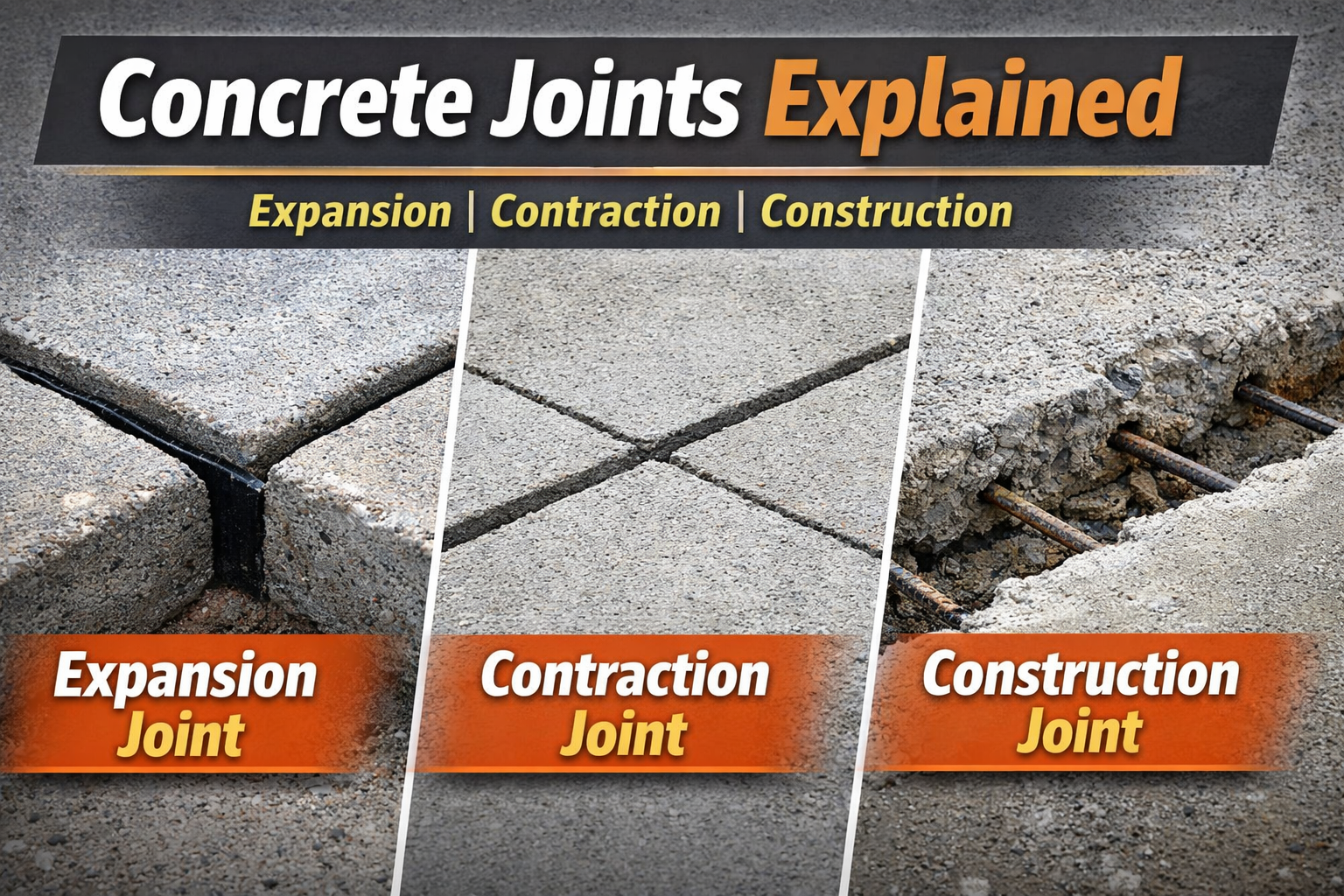
In this blog, we will explore expansion joints, contraction joints, and construction joints in detail with practical site insights, materials, and installation techniques.
2. Types of Concrete Joints
Concrete joints are classified based on their function and structural behavior.
2.1 Expansion Joints
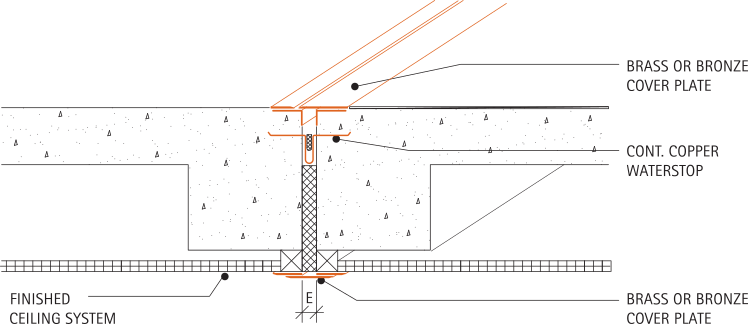


Expansion joints are provided to absorb thermal expansion in concrete structures.
🔹 Why needed?
Concrete expands when temperature increases. Without space to expand, internal stresses develop, leading to cracks.
🔹 Where used?
- Long buildings
- Bridges
- Pavements
- Retaining walls
🔹 Key Features:
- Full-depth separation joint
- Filled with compressible material
- Allows movement without stress
🔹 Materials used:
- Bituminous filler boards
- Rubber or cork sheets
- Fiberboard
🔹 Practical Example:
In a 30m long concrete pavement, expansion joints are typically provided at intervals of 20–30 meters.
2.2 Contraction Joints (Control Joints)


Contraction joints are designed to control cracking caused by shrinkage.
🔹 Why needed?
Concrete shrinks as it dries. This creates tensile stress, which leads to random cracking.
🔹 Function:
- Creates a planned weak point
- Forces cracks to occur in a straight line
🔹 Methods:
- Saw cutting
- Grooving
- Tooling during finishing
🔹 Depth rule:
Typically 1/4th of slab thickness
🔹 Spacing:
- 24–36 times slab thickness
🔹 Example:
For a 150 mm slab → joint spacing ≈ 3.5 to 4.5 m
2.3 Construction Joints


Construction joints are provided when concreting work is stopped and resumed later.
🔹 Why needed?
Concrete cannot always be poured continuously due to:
- Large structures
- Work scheduling
- Equipment limitations
🔹 Types:
- Horizontal joints
- Vertical joints
🔹 Important considerations:
- Surface roughening
- Bonding agents
- Proper alignment
🔹 Example:
- Between two casting days in columns or slabs
3. Materials Used in Concrete Joints
3.1 Joint Fillers


Joint fillers are used in expansion joints to absorb movement.
🔹 Properties:
- Compressible
- Durable
- Non-reactive
🔹 Types:
- Bituminous fiberboard
- Cork board
- Rubber sheets
3.2 Sealants


Sealants are applied to seal joints and prevent water entry.
🔹 Types:
- Polysulfide
- Polyurethane
- Silicone
🔹 Components:
- Primer
- Backer rod
- Sealant material
🔹 Benefits:
- Waterproofing
- Flexibility
- Crack prevention
3.3 Waterstops


4
Waterstops are used in water-retaining structures.
🔹 Function:
Prevent water leakage through joints.
🔹 Types:
- PVC waterstops
- Rubber waterstops
- Metal waterstops
🔹 Applications:
- Basements
- Water tanks
- Dams
4. Installation Guidelines
Proper installation is critical for performance.
🔹 Expansion Joints:
- Place filler board correctly
- Ensure proper alignment
- Provide sealant groove
🔹 Contraction Joints:
- Cut within 6–12 hours after casting
- Maintain uniform spacing
🔹 Construction Joints:
- Clean surface thoroughly
- Roughen surface
- Apply bonding agent
🔹 Waterstop Installation:
- Ensure correct positioning
- Avoid displacement during concreting
- Proper splicing is essential
5. Practical Site Tips
✔ Always clean joints before sealing
✔ Use oil-free compressed air
✔ Ensure proper curing before sealing
✔ Avoid sealing in wet conditions
✔ Maintain temperature limits (>5°C recommended)
6. Common Mistakes to Avoid
❌ Improper joint spacing
❌ Poor sealant application
❌ Misaligned joints
❌ Damaged waterstops
❌ No bond breaker usage
7. Conclusion
Joints are not weaknesses — they are engineered solutions that enhance durability.
Proper design and execution of:
- Expansion joints
- Contraction joints
- Construction joints
- Side Cladding Runner Details for PEB Structures
 Introduction Side cladding runners are one of the most important… Read more: Side Cladding Runner Details for PEB Structures
 - Expansion Joints in Concrete Pavements
 Concrete pavements are designed to withstand heavy traffic loads, temperature… Read more: Expansion Joints in Concrete Pavements
 - RCC Staircase Detail Drawing free pdf Download
 Reinforced Cement Concrete (RCC) staircases are one of the most… Read more: RCC Staircase Detail Drawing free pdf Download
 - Pipe Rack GA Drawing Layout
 Image – Typical Pipe Rack GA Drawing Explanation The above… Read more: Pipe Rack GA Drawing Layout
 - Bund Wall Detail Drawing for Tank Farm and Oil Storage Area
 Introduction A bund wall (also called a dyke wall or… Read more: Bund Wall Detail Drawing for Tank Farm and Oil Storage Area
 - Dyke Wall Layout and Detail | Oil Tank Containment Systems |
 Introduction A dyke wall (also called a bund wall or… Read more: Dyke Wall Layout and Detail | Oil Tank Containment Systems |
 - How to Assign LY and LZ in STAAD for Steel Structures (With and Without Bracing)
 🔹 What is LY and LZ? In STAAD.Pro: These define… Read more: How to Assign LY and LZ in STAAD for Steel Structures (With and Without Bracing)
 - EDG Building Power Cable Layout with MTO Guide
 Introduction An Emergency Diesel Generator (EDG) system is a critical… Read more: EDG Building Power Cable Layout with MTO Guide
 - Septic Tank Drawing and Details
 Septic tanks are widely used in residential buildings for on-site… Read more: Septic Tank Drawing and Details
 - Holding Tank Detail
 Introduction A holding tank, also known as a water sump… Read more: Holding Tank Detail
 - Rain Water Harvesting System pdf Book Download
 TABLE OF CONTENTS 1.0 INTRODUCTION 3 2.0 CHAPTER 1 4… Read more: Rain Water Harvesting System pdf Book Download
 - Galvanized Gate | Design Details and Specifications Guide |
 Introduction Industrial galvanized gates are designed for heavy-duty usage, high… Read more: Galvanized Gate | Design Details and Specifications Guide |
 - Soak Pit Details | Seepage Pit |
 Introduction A soak pit or seepage pit (also called a… Read more: Soak Pit Details | Seepage Pit |
 - Expansion, Contraction and Construction Joints in Concrete for Civil Works
 1. Introduction Concrete is one of the most widely used… Read more: Expansion, Contraction and Construction Joints in Concrete for Civil Works
 - Cable Rack Structural Steel Detail and Design
 Introduction Cable racks (also called cable trays or cable support… Read more: Cable Rack Structural Steel Detail and Design
 - RCC Shear Wall Details
 Introduction Reinforced Cement Concrete (RCC) shear walls are one of… Read more: RCC Shear Wall Details
 - RCC Column with Splice and Coupler in Reinforcement Free Download
 Introduction Reinforced Cement Concrete (RCC) columns are one of the… Read more: RCC Column with Splice and Coupler in Reinforcement Free Download
 - Manhole Types and Details
 Manholes are essential underground structures used in sewer systems, stormwater… Read more: Manhole Types and Details
 - Catch Basin Types and Details
 Catch basins are essential components of stormwater management systems. They… Read more: Catch Basin Types and Details
 - Foundation Detail Drawings for Buildings With CAD Files
 A Practical Structural Drawing Guide Introduction Footing drawings form the… Read more: Foundation Detail Drawings for Buildings With CAD Files
 - Bar Bending Schedule | BBS Calculator For Beam Column and Slab
 Managing the Bar Bending Schedule (BBS) is one of the… Read more: Bar Bending Schedule | BBS Calculator For Beam Column and Slab
 - Room Paint Calculator | Paint, Primer & Putty Quantity & Cost Estimator
 Looking to renovate your room? Our Room Paint, Primer &… Read more: Room Paint Calculator | Paint, Primer & Putty Quantity & Cost Estimator
 - Brick Wall Construction Calculator | Calculate Bricks & Cost Instantly |
 Introduction Building a brick wall requires accurate planning to avoid… Read more: Brick Wall Construction Calculator | Calculate Bricks & Cost Instantly |
 - Unit Converter – Feet, Inches, cm, mm, Yard to Meter and Vice Versa
 Length Unit Converter 🌙 Toggle Dark Mode Length Unit Converter… Read more: Unit Converter – Feet, Inches, cm, mm, Yard to Meter and Vice Versa
 - Civil Engineering Interview Questions and Important Practical Foundation
 1. What factors affect the selection of foundation type? Soil… Read more: Civil Engineering Interview Questions and Important Practical Foundation