
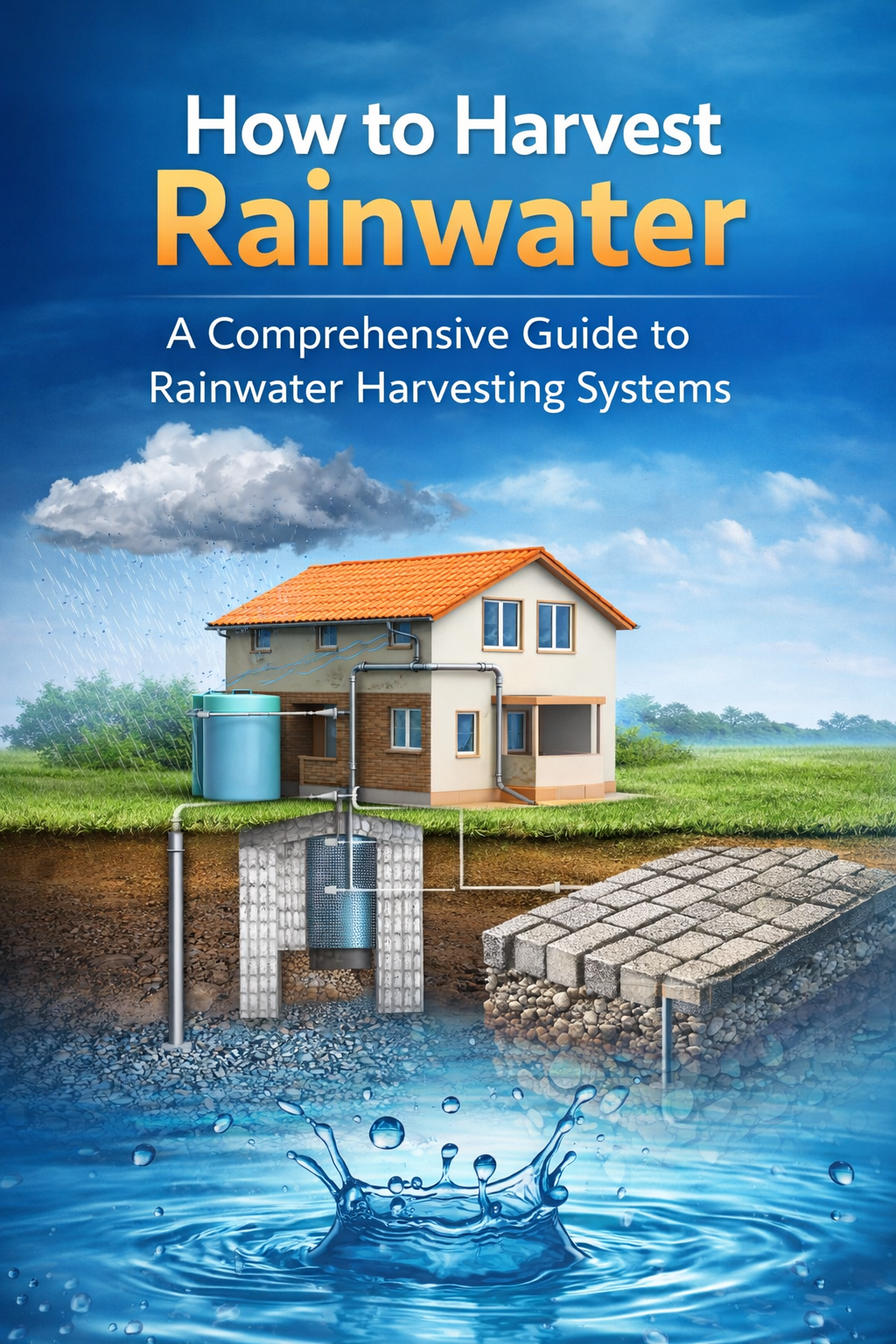

TABLE OF CONTENTS
1.0 INTRODUCTION 3
2.0 CHAPTER 1 4
2.1 THE URBAN WATER CRISIS 4
3.0 CHAPTER 2 6
3.1 THE CONCEPT OF WATER HARVESTING 6
4.0 CHAPTER 3 9
4.1 HOW TO HARVEST RAINWATER 9
INTRODUCTION
The Centre for Science and Environment (CSE) has been involved in raising awareness about the need of community-based water management for a number of years. Unless people are involved from individual households, farmers and industrialists to urban and rural communities — we feel that it will be very difficult to meet the looming water crisis. A water crisis that has come about because rain, as a source of water has been ignored. The potential of rain to meet water demands is tremendous. Theoretically, the average rainfall of 100 mm of rain falling on one hectare of land in arid regions like Jaisalmer can yield up to one million litres of water.
As a technological solution CSE is therefore promoting the concept of community and household-based water harvesting, as this decentralised technology can be adopted by all concerned and also promote a participatory paradigm of water management.
Our efforts include the publication of the widely acclaimed book on traditional water harvesting systems, Dying Wisdom: Rise, Fall and Potential of India’s Traditional Water Harvesting Systems, released in 1997. In October 1998, we had an international conference on Potential of water harvesting: traditions, policies and social mobilisation. One of the outcomes of this has been the establishment of a National Water Harvesters’ Network to bring the like-minded together.
An indicator of the success of our campaign has been the requests that we have been deluged with regarding implementation of water harvesting in urban areas. What is more encouraging to us is the fact that people are now concerned about water management and availability and are willing to play an active role in managing water and meeting their demands. To reach a wider audience, we decided to publish a series of manuals on water harvesting as well as conduct training workshops.
This manual has been compiled with the objective of presenting the basics required for undertaking water harvesting. The manual is made in a simple form so that it can be used even by ordinary householders, apart from architects, engineers and other professionals interested in implementing water harvesting.
Apart from various methods and techniques for water harvesting, a few case studies of water harvesting systems designed by CSE in Delhi have been cited so that establishments with similar conditions can take up water harvesting on the same lines. This manual presents methods suitable mainly for singular building/establishment level — residences, institutions and industries. The scope of water harvesting can be extended to a locality/community level by incorporating various such singular units into a group.
As one will gather through the manual, broadly there are two approaches to harvesting water — storing of water for direct use or recharging of groundwater. Since recharging of groundwater is more feasible for the climatic condition of Delhi, more attention has been paid to the groundwater recharging aspects of water harvesting.
This manual is by no means comprehensive, since there are no limits to innovation in techniques that can be applied. The manual is seen as just a beginning; we plan to update it over time corresponding to the development and fine-tuning of the existing methods of water harvesting.
We welcome comments, additions and corrections to be included in future editions.
CHAPTER 1
THE URBAN WATER CRISIS
India has more than 285 million city-dwellers even though the rate of urbanization is among the lowest in the world. The percentage of urban dwellers in India keeps increasing — from 10.8 per cent in 1901 to 17.3 per cent in 1951 and 25.7 per cent in 1991. Rural-urban migration and high demographic natural increase in cities will further increase the proportion to more than 50 per cent of the total population by 2020.
Mumbai, Calcutta and Delhi already have more than 10 million inhabitants while more than 23 Indian cities have a population above a million. In most of these cities, the water supply sector is faced with a number of problems and constraints. Freshwater sources are being heavily exploited to meet the demands of the urban populace.
As surface water sources fail to meet rising demands, groundwater reserves are tapped, often to unsustainable levels. Almost all cities depending on groundwater are faced with rapid depletion of their water tables. In Ahmedabad, the water table has gone down by more than 90 m since 1965.
In addition to quantity, the country also faces problems of water quality. Overextraction of groundwater in Chennai has led to salinity intrusion in the coastal aquifers. Chennai had to bring water from the surrounding rural areas, leading to rural-urban conflicts.
The water crisis in Delhi
The city of Delhi is almost perpetually in the grip of a water crisis, more so during the dry season when serious water shortages afflict the city. A large number of residents depend on groundwater to augment the municipal supply. Delhi has no right over the Yamuna and is supplied by surface water from the Yamuna and the dam on river Beas from its neighbouring states.
The population of Delhi, according to the 2001 census, was 12.7 million, which is expected to cross 30 million by 2021. Against the present requirement of about 830 million gallon/day (MGD), the supply is only 650 MGD.
Although the average water consumption in Delhi is estimated at 240 litres per capita per day (lpcd), the highest in India, the figure is not indicative of an adequate supply to every resident since the water supply is far from being uniformly distributed. The NDMC and Delhi Cantonment areas get an average supply of about 450 lpcd, while areas in Narela and Mehrauli zones get less than 35 lpcd.
The gap between the supply and demand of water has resulted in large-scale development (read, over-extraction) of groundwater. This has led to serious problems with both quantity and quality of groundwater.
Unsustainable groundwater use
Delhi-ites are a major groundwater-dependent community. Of the water supplied by the municipality, approximately 11 per cent comes from groundwater reserves. However, it is difficult to establish the total quantity of groundwater extracted, because a large number of private tubewells dug by households and the industrial sector for their own supply are unaccounted for in the official figures. Many water tanker and bottled water companies are drawing and selling groundwater.
Unplanned and uncontrolled extraction of groundwater has disturbed the hydrological balance, leading to decline in productivity of wells, rise in energy requirement and deterioration in quality of water.
There has been a widespread drop in the groundwater table in Delhi, especially in the south and southwestern localities of Delhi.
The water table has depleted by 2 to 8 m in the past decade. The lack of regulation related to private or individual extraction of groundwater aggravates this situation. In addition to over-exploitation of groundwater, the uncontrolled disposal of effluents and sewage in the city has contaminated the groundwater to alarming levels. Studies conducted by the Central Ground Water Board in Delhi revealed that groundwater in most parts of Delhi is contaminated with fluoride and nitrate and is unfit for drinking without treatment.
UNDERSTANDING GROUNDWATER
Contrary to popular belief, groundwater reserves are not in the form of lakes or streams of water inside the ground. Water in the ground is stored in the interstices (inter-particulate spaces) of the soil or rock that forms the earth. It is similar to water being stored in a sponge — it is not visible, but can be ‘squeezed’ out (or drawn out). A simple experiment is illustrated below.
The soil or rock formations in the earth that contain water are called groundwater aquifers. Below a certain depth in the ground, the earth is saturated. Saturation is a state in which all the free spaces or interstices are filled with water. This level is referred to as the groundwater level. This level may be just below the ground level or many hundred metres below ground level. In the Delhi area, groundwater levels vary between 3 to 60 metres below ground level.

How is groundwater formed?
When rain falls on the surface of the earth, some amount of water percolates through the soil and moves downwards under the effect of gravity. When water moves through the soil, it is said to be infiltrating, because it gets filtered in the process of passing through the pores of the soil. Groundwater aquifers are formed over many years, as infiltration from successive rains joins the existing groundwater.
What is groundwater depletion?
Heavy extraction of groundwater leads to an imbalance in the groundwater reserves as the withdrawal of water is more than the recharge. This leads to depletion of the groundwater resources. Depth to water increases and wells become dry.
CHAPTER 2
THE CONCEPT OF WATER HARVESTING
Definition of water harvesting
In scientific terms, water harvesting refers to collection and storage of rainwater and also other activities aimed at harvesting surface and groundwater, prevention of losses through evaporation and seepage and all other hydrological studies and engineering interventions, aimed at conservation and efficient utilization of the limited water endowment of physiographic unit such as a watershed.
In general, water harvesting is the activity of direct collection of rainwater. The rainwater collected can be stored for direct use or can be recharged into the groundwater.
Rain is the first form of water that we know in the hydrological cycle, hence is a primary source of water for us. Rivers, lakes and groundwater are all secondary sources of water. In present times, we depend entirely on such secondary sources of water. In the process, it is forgotten that rain is the ultimate source that feeds all these secondary sources and remain ignorant of its value. Water harvesting means to understand the value of rain, and to make optimum use of rainwater at the place where it falls.

Need for water harvesting
We get a lot of rain, yet we do not have water. Why? Because we have not reflected enough on the value of the raindrop. The annual rainfall over India is computed to be 1,170 mm (46 inches). This is higher compared to the global average of 800 mm (32 inches). However, this rainfall occurs during short spells of high intensity. Because of such intensities and short duration of heavy rain, most of the rain falling on the surface tends to flow away rapidly, leaving very little for the recharge of groundwater. This makes most parts of India experience lack of water even for domestic uses.
Ironically, even Cherrapunji which receives about 11,000 mm of rainfall annually suffers from acute shortage of drinking water. This is because the rainwater is not conserved and allowed to drain away. Thus it does not matter how much rain we get, if we don’t capture or harvest it.
This highlights the need to implement measures to ensure that the rain falling over a region is tapped as fully as possible through water harvesting, either by recharging it into the groundwater aquifers or storing it for direct use.
How much water can be harvested?
The total amount of water that is received in the form of rainfall over an area is called the rainwater endowment of that area. Out of this, the amount that can be effectively harvested is called the water harvesting potential.
Water harvesting potential = Rainfall (mm) × Collection efficiency
The collection efficiency accounts for the fact that all the rainwater falling over an area cannot be effectively harvested, because of evaporation, spillage etc. Factors like runoff coefficient and the first-flush wastage are taken into account when estimating the collection efficiency.
The following is an illustrative theoretical calculation that highlights the enormous potential for rainwater harvesting. The same procedure can be applied to get the potential for any plot of land or rooftop area, using rainfall data for that area.
Consider a building with a flat terrace area of 100 sq. m. The average annual rainfall in Delhi is approximately 600 mm.
In simple terms, this means that if the terrace floor is assumed to be impermeable, and all the rain that falls on it is retained without evaporation, then, in one year, there will be rainwater on the terrace floor to a height of 600 mm.
Area of plot = 100 sq. m
Height of rainfall = 0.6 m (600 mm or 24 inches)
Volume of rainfall over the plot = Area × Height
= 100 sq. m × 0.6 m
= 60 cu. m (60,000 litres)
Assuming that only 60% of the total rainfall is effectively harvested:
Volume of water harvested = 36,000 litres (60,000 × 0.6)

This volume is about twice the annual drinking water requirement of a 5-member family. The average daily drinking water requirement per person is 10 litres.
The case of Delhi
Delhi has an annual average rainfall of 611.8 mm. However, recharge to groundwater is limited because of decreasing availability of permeable soil surfaces due to the existence of roads and buildings.
As a result of poor recharge and heavy extraction of groundwater, groundwater levels in Delhi have declined by as much as 8 metres in the past decade. Groundwater can be a sustainable source of water only if it is ensured that the amount of water withdrawn is compensated by recharging an equal amount of rainwater into the ground.
Water harvesting provides the means to recharge the groundwater, thereby maintaining the balanced situation of the resource.
Rainwater harvesting has a huge potential in Delhi. With an area of 1,486 sq. km, the rainwater harvesting potential of Delhi comes to about 907 billion litres annually. This is equal to about 270 days of water requirement for the entire city.
The entire annual rainfall is received over a period of 27 days, 80 per cent of which falls between July to September. The rainwater therefore has to be harvested during this short period.
CHAPTER 3
HOW TO HARVEST RAINWATER
Broadly, rainwater can be harvested for two purposes:
- Stored for ready use in containers above ground or below ground
- Charged into soil for withdrawal later (groundwater recharging)
Elements of a Typical Water Harvesting System
- Catchments
The catchment of a water harvesting system is the surface which receives rainfall directly and contributes the water to the system. It can be a paved area like a terrace or courtyard of a building, or an unpaved area like a lawn or open ground. Temporary structures like sloping sheds can also act as catchments. - Conduits
Conduits are the pipelines or drains that carry rainwater from the catchment or rooftop to the harvesting system. Conduits may be of any material like polyvinyl chloride (PVC), asbestos or galvanized iron (GI), materials that are commonly available.


RUNOFF
Runoff is the term applied to the water that flows away from a catchment after falling on its surface in the form of rain. Runoff can be generated from both paved and unpaved catchment areas of buildings.
The nature of the catchment determines the quantity of runoff that occurs from the area. For example, about 70 per cent of the rainfall that occurs over the tiled surface of a terrace would flow as runoff while only 10 per cent of the rainfall on a wooded or grassy area would flow, the rest being retained on the surface and getting percolated into the ground.

From the point of view of quality, runoff can be divided into two types:
- Runoff from paved surfaces (e.g., roofs and courtyards)
- Runoff from unpaved surfaces (e.g., lawns and playgrounds)

Quality of runoff from paved surfaces is better since runoff from unpaved surfaces may have bacterial or other contamination. If water is to be stored for drinking purposes, it is advisable that only runoff from paved surfaces is used.
3a. Storage Facility
Rainwater can be stored in any commonly used storage containers like RCC, masonry or plastic water tanks. Some maintenance measures like cleaning and disinfection are required to ensure the quality of water stored in the container.
3b. Recharge Facility
Alternative to storing, rainwater may be charged into the groundwater aquifers. This can be done through any suitable structures like dugwells, borewells, recharge trenches and recharge pits.
Methods of Harvesting Water
As illustrated earlier, there are two broad approaches:
- Storing rainwater for direct use
- Recharging groundwater aquifers
PART 1: Storing Rainwater for Direct Use
Rooftop harvesting has been practiced since ages, and even today it is practiced in many places throughout the world. In some cases, the rooftop harvesting system is little more than a split pipe or bamboo directing runoff from the roof into an old oil drum placed near the roof.
In Ahmedabad, which has a climate similar to that of Delhi, traditional rainwater harvesting tanks which store drinking water can be seen even today in some old houses.

Should Water be Stored or Recharged?
The decision whether to store or recharge water depends on the rainfall pattern of a particular region.
- In places like Kerala and Mizoram, rain falls throughout the year, barring a few dry periods. In such places, one can depend on a small domestic-sized water tank for storing rainwater.
- In dry areas like Delhi, Rajasthan and Gujarat, the total annual rainfall occurs only during 3 or 4 months of monsoon. The water collected during the monsoon has to be stored throughout the year, which means huge volumes of storage containers would have to be provided.
In Delhi, it is more feasible to use rainwater to recharge groundwater aquifers rather than for storage.

Storage System Details
Generally, runoff from only paved surfaces is used for storing, since it is relatively free of bacteriological contamination. Drainpipes that collect water from the catchment (rooftop) are diverted to the storage container.
To prevent leaves and debris from entering the system:
- Mesh filters should be provided at the mouth of the drain pipe
- A first-flush device should be provided
- If water is used for drinking, a sand filter should also be provided
An underground RCC/masonry tank can be used for storage of rainwater. The tank can be installed inside the basement of a building or outside the building. Pre-fabricated tanks such as PVC can also be installed above the ground.
Each tank must have an overflow system for situations when excess water enters the tank. The overflow can be connected to the drainage system.
Design of Storage Tank
The quantity of water stored in a water harvesting system depends on:
- Size of the catchment area
- Size of the storage tank
- Water requirements
- Rainfall and catchment availability

FIRST-FLUSH DEVICE
A first-flush device is a valve or a simple device which is used to ensure that runoff from the first spell of rain is flushed out and does not enter the system. This needs to be done since the first spell of rain carries with it a relatively larger amount of pollutants from the air and catchment surface.
Design Parameters for Storage Tanks
- Average annual rainfall
- Size of the catchment
- Drinking water requirement
Suppose the system has to be designed for meeting drinking water requirement of a 5-member family living in a building with a rooftop area of 100 sq. m. Average annual rainfall in the region is 600 mm (average annual rainfall in Delhi is 611 mm). Daily drinking water requirement per person (drinking and cooking) is 10 litres.
We shall first calculate the maximum amount of rainfall that can be harvested from the rooftop:
Available data:
- Area of catchment (A) = 100 sq. m
- Average annual rainfall (R) = 611 mm (0.61 m)
- Runoff coefficient (C) = 0.85
Annual water harvesting potential:
= A × R × C
= 100 × 0.6 × 0.85
= 51 cu. m (51,000 litres)
The tank capacity has to be designed for the dry period (time between two rainy seasons). With a monsoon of about 4 months, the dry period is 245 days.
Drinking water requirement:
= 245 × 5 × 10
= 12,250 litres
Adding 20% safety factor:
= 14,700 litres
RUNOFF COEFFICIENT
Runoff coefficient is the factor which accounts for the fact that all the rainfall falling on a catchment cannot be collected. Some rainfall will be lost from the catchment by evaporation and retention on the surface itself.
Table 3.1 Runoff coefficients for various surfaces
Type of Catchment — Coefficients
Roof Catchments
- Tiles → 0.8 – 0.9
- Corrugated metal sheets → 0.7 – 0.9
Ground surface coverings
- Concrete → 0.6 – 0.8
- Brick pavement → 0.5 – 0.6
Untreated ground catchments
- Soil on slopes less than 10 per cent → 0.0 – 0.3
- Rocky natural catchments → 0.2 – 0.5
Source: Pacey, Arnold and Cullis, Adrian, 1989, Rainwater Harvesting: The collection of rainfall and runoff in rural areas, Intermediate Technology Publications, London, pg. 55
Quality of Stored Water
Rainwater collected from rooftops is free of mineral pollutants like fluoride and calcium salts which are generally found in groundwater. But, it is likely to be contaminated with these types of pollutants:
- Air pollutants
- Surface contamination (e.g., silt, dust)
Measures to Ensure Water Quality
All these types of contaminations can be prevented to a large extent by ensuring that the runoff from the first 10–20 minutes of rainfall is flushed off.
Most of the debris carried by the water from the rooftop like leaves, plastic bags and paper pieces is arrested by the grill at the terrace outlet for rainwater. Remaining contaminants like silt and blow dirt can be removed by sedimentation (settlement) and filtration (see box: Disinfecting water at a household level on p12).
Contrary to popular belief, water quality improves over time during storage in the tank because impurities settle in the tank if the water is not disturbed. Even pathogenic (harmful) organisms gradually die out due to storage.
Additionally, biological contamination can be removed by disinfecting the water. Many simple methods of disinfection are available which can be done at a domestic level (see box: Disinfecting water at a household level on p11).
Specifications for drinking water are given by IS: 10500 and World Health Organisation (WHO).
PART 2: Recharging Groundwater Aquifers
Various kinds of recharge structures are possible which can ensure that rainwater percolates into the ground instead of draining away from the surface. While some structures promote the percolation of water through soil strata at shallower depth (e.g., recharge trenches, permeable pavements), others conduct water to greater depths from where it joins the groundwater (e.g., recharge wells).
At many locations, existing features like wells, pits and tanks can be modified to be used as recharge structures, eliminating the need to construct any structures afresh.
A few commonly-used recharging methods are explained here. Innumerable innovations and combinations of these methods are possible.
DISINFECTING WATER AT A HOUSEHOLD LEVEL
Boiling
Boiling is a very effective method of purification and very simple to carry out. Boiling water for 10 to 20 minutes is enough to remove all biological contaminants.
Chemical Disinfection
a. Chlorination
Chlorination is done with stabilised bleaching powder (calcium hypochlorite – CaOCl₂), which is a mixture of chlorine and lime. Chlorination can kill all types of bacteria and make water safe for drinking purposes. About 1 gm (approximately 1/4 tea spoon) of bleaching powder is sufficient to treat 200 litres of water.
b. Chlorine tablets
Chlorine tablets are easily available commercially. One tablet of 0.5 g is enough to disinfect 20 litres (a bucketful) of water.
Filtration
a. Charcoal water filter
A simple charcoal filter can be made in a drum or an earthen pot. The filter is made of gravel, sand and charcoal, all of which is easily available.
b. Sand filters
Sand filters have commonly available sand as filter media. Sand filters are easy and cheap to construct. These filters can be employed for treatment of water to effectively remove turbidity (suspended particles like silt and clay), colour and microorganisms from the water.
c. Ceramic filters
These filters are manufactured commercially on a wide scale. Most of the water purifiers available in the market are of this type.

Figure Details (from diagram)
Figure 3.12 – Composition of a charcoal filter
- 10 cm gravel layer
- 10 cm charcoal layer
- 25 cm sand layer
- 25 cm gravel layer
Figure 3.13 – Simple sand filter (domestic level)
- 20 cm gravel layer
- 30 cm sand layer
- 20 cm gravel layer
- Porous bed
1. Borewells / dugwells
Figures 3.14 and 3.15 show typical systems of recharging wells directly with rooftop runoff. Rainwater that is collected on the rooftop of the building is diverted by drainpipes to a settlement or filtration tank, from which it flows into the recharge well (borewell or dugwell).
If a borewell is used for recharging, then the casing (outer pipe) of the borewell should preferably be a slotted or perforated pipe so that more surface area is available for the water to percolate. Developing a borewell would increase its recharging capacity (developing is the process where water or air is forced into the well under pressure to loosen the soil strata surrounding the bore to make it more permeable).

Figure 3.14 Recharge assembly for borewell
If a dugwell is used for recharge, the well lining should have openings (weep-holes) at regular intervals to allow seepage of water through the sides. Dugwells should be covered to prevent mosquito breeding and entry of leaves and debris. The bottom of recharge dugwells should be desilted annually to maintain the intake capacity.

Figure 3.15 Recharge assembly for dugwell with rooftop runoff
Precautions should be taken to ensure that physical matter in the runoff like silt and floating debris do not enter the well since it may cause clogging of the recharge structure. It is preferred that the dugwell or borewell used for recharging be shallower than the water table (see figure 3.17 on p13). This ensures that the water recharged through the well has a sufficient thickness of soil medium through which it has to pass before it joins the groundwater (see box: Understanding groundwater on p2). Any old well which has become defunct can be used for recharging, since the depth of such wells is above the water level.
Quality of water recharged
The quality of water entering the recharging wells can be ensured by providing the following elements in the system:
- Filter mesh at entrance point of rooftop drains
- Settlement chamber
- Filter bed

Figure 3.16 Recharge assembly for dugwell with runoff from ground areas (non-rooftop)
Design parameters for settlement tank
For designing the optimum capacity of the tank, following aspects have to be considered:
- Size of the catchment
- Intensity of rainfall
- Rate of recharge
Since the desilting tank also acts as buffer tank, it is designed such that it can retain a certain amount of rainfall, since the rate of recharge may not be comparable with the rate of runoff. The capacity of the tank should be enough to retain the runoff occurring from conditions of peak rainfall intensity.

Figure 3.17 Recharge wells should preferably be shallower than the water table
Groundwater level
Depth of soil medium available for infiltration
In Delhi, peak hourly rainfall is 90 mm (based on 25 year frequency). The rate of recharge in comparison to runoff is a critical factor. However, since accurate recharge rates are not available without detailed geohydrological studies, the rates have to be assumed. The capacity of recharge tank is designed to retain runoff from at least 15 minutes rainfall of peak intensity (For Delhi, 22.5 mm/hr, say, 25 mm).
Suppose the following data is available:
Area of rooftop catchment (A) = 100 sq. m.
Peak rainfall in 15 min (r) = 25 mm (0.025 m)
Runoff coefficient (C) = 0.85
Then, capacity of desilting tank
= A × r × C
= 100 × 0.025 × 0.85
= 2.125 cu. m. (2,125 litres)
SETTLEMENT TANK
Settlement tanks are used to remove silt and other floating impurities from rainwater. A settlement tank is like an ordinary storage container having provisions for inflow (bringing water from the catchment), outflow (carrying water to the recharge well) and overflow. A settlement tank can have an unpaved bottom surface to allow standing water to percolate into the soil.
Apart from removing silt from the water, the desilting chamber acts like a buffer in the system. In case of excess rainfall, the rate of recharge, especially of borewells, may not match the rate of rainfall. In such situations, the desilting chamber holds the excess amount of water till it is soaked up by the recharge structure.
Options for settlement tank
Any container with adequate capacity of storage can be used as a settlement tank. Generally, masonry or concrete underground tanks are preferred since they do not occupy any surface area (see figure 3.18). Old disused tanks can be modified to be used as settlement tanks (see case study 8 on p-34).
For overground tanks, pre-fabricated PVC or ferrocement tanks can be used. Pre-fabricated tanks are easier to install, compared to masonry and concrete tanks (see figure 3.19).
2. Recharge pits (Recharge well)
A recharge pit is a pit 1.5 m to 3 m wide and 2 m to 3 m deep. The excavated pit is lined with a brick/stone wall with openings (weep-holes) at regular intervals. The top area of the pit can be covered with a perforated cover (see figure 3.20 on p15).
The method for designing a recharge pit is similar to that for a settlement tank.

Figure 3.18 Underground masonry settlement tank

Figure 3.19 Overground PVC settlement tank
3. Soakaways (Percolation pit)
A soakaway is a bored hole of up to 30 cm diameter drilled in the ground to a depth of 3 to 10 m. The soakaway can be drilled with a manual auger unless hard rock is found at a shallow depth. The borehole can be left unlined if a stable soil formation like clay is present. In such a case, the soakaway may be filled up with a filter media like brickbats. In unstable formations like sand, the soakaway should be lined with a PVC or MS pipe to prevent collapse of the vertical sides (see Case Study 1 on p19). The pipe may be slotted/perforated to promote percolation through the sides.
A small sump is built at the top end of the soakaway where some amount of runoff can be retained before it infiltrates through the soakaway. Since the sump also acts like a buffer in the system, it has to be designed on the basis of expected runoff as described for settlement tanks.vertical sides. The pipe may be slotted/perforated to promote percolation through the sides.
A small sump is built at the top end of the soakaway where some amount of runoff can be retained before it infiltrates through the soakaway. Since the sump also acts like a buffer in the system, it has to be designed on the basis of expected runoff as described for settlement tanks.
4. Recharge trenches
Recharging through recharge trenches, recharge pits and soakaways is simpler compared to recharge through wells. Fewer precautions have to be taken to maintain the quality of the rainfall runoff. For these type of structures, there is no restriction on the type of catchment from which water is to be harvested, i.e., both paved and unpaved catchments can be tapped.
A recharge trench is simply a continuous trench excavated in the ground and refilled with porous media like pebbles, boulders or brickbats.

Figure 3.20
Location of recharge pit in a building area and detailed section of pit
Labels:
- Ground level
- Brick wall (230 mm)
- PCC footing
- RCC slab
- Slab
- Sand
- Pebbles
- Recharge bore (150 mm dia)
- Slotted casing with coir wrapping
Figure 3.21
Location of soakaways in a building area with detailed section of soakaway
Labels:
- Perforated RCC slab
- Cap
- Brick wall
- Pebbles
- Slotted pipe
- Jute coir
- Perforated RCC slab (plan view)
or brickbats (see figure 3.22). A recharge trench can be 0.5 m to 1 m wide and 1 m to 1.5 m deep. The length of the recharge trench is decided as per the amount of runoff expected. The recharge trench should be periodically cleaned of accumulated debris to maintain the intake capacity.
In terms of recharge rates, recharge trenches are relatively less effective since the soil strata at depth of about 1.5 metres is less permeable. To enhance the recharge rate, percolation pits can be provided at the bottom of the trench.
Design of a recharge trench
The methodology of design of a recharge trench is similar to that for designing a settlement tank. The difference is that the water holding capacity of a recharge trench is less than its gross volume because it is filled with porous material. A factor of loose density (voids ratio) of the media has to be applied to the equation.
Using the same method as used for design of settlement tank:
- Area of rooftop catchment (A) = 100 sq. m.
- Peak rainfall in 15 min (r) = 25 mm (0.025 m)
- Runoff coefficient (C) = 0.85
- Voids ratio (D) = 0.5 (assumed)
Required capacity of recharge tank:
= (A × r × C) / D
= (100 × 0.025 × 0.85) / 0.5
= 4.25 cu. m. (4,250 litres)
The voids ratio of the filler material varies with the kind of material used, but for the commonly-used materials like brickbats, pebbles and gravel, a voids ratio of 0.5 may be assumed.
In designing a recharge trench, the length of the trench is an important factor. Once the required capacity is calculated as illustrated above, length can be calculated by considering a fixed depth and width.
5. Permeable Surfaces
Unpaved surfaces have a greater capacity of retaining rainwater on the surface. A patch of grass would retain a large proportion of the rainwater falling on it, yielding only 10–15 per cent as runoff (see figure 3.6 on p6). A considerable amount of water retained on such a surface will naturally percolate in the ground. Such surfaces contribute to the natural recharge of groundwater.
If paving of ground surfaces is unavoidable, one may use pavements which retain rainwater and allow it to percolate into the ground (see figure 3.23 on p17).

Figure 3.22: Details of recharge through with percolation pits
Labels:
- Brick Wall (230 mm)
- PCC Footings
- Pebbles
- Recharge bore
- Slotted pipe (Coir wrapped)
- Percolation Trenches
- Metal Grill
- Brick flooring
- Cap at the top
- PCC base

Figure 3.23 Permeable Pavements
- Hollow concrete paving blocks
- Clay bricks
- Sand filled in joints
Special precautions
Whether the harvested water is used for direct usage or for recharging the groundwater, it is of utmost importance to ensure that the rainwater collected is free of any pollutants that might be added to rainwater from the atmosphere or the catchment. While polluted water directly used for consumption would have an immediate impact on health, polluted water recharged into the ground would cause long-term problems of aquifer pollution. Damage done to aquifers by recharging polluted water is irreversible.
Most of the precautions to ensure rainwater quality have been described earlier in the manual. Here, all the measures have been summarised:
1. At the catchment level
- Keeping the catchment clean
- Using gratings to trap debris at the catchment itself
- Paving the catchment with ceramic tiles, stone tiles or other such non-erosive materials
2. At the conduit level
3. Before recharging
- Provision of first-flush to drain runoff from initial spell of rain
- Allowing for sedimentation of the water
- Filtering the water
In establishments like industries, it is very necessary to ensure that the catchment surfaces are free of chemical wastes, fuels, lubricants etc. While physical and biological impurities in water can be easily removed by desedimentation and filtration, it is difficult to remove chemical impurities.
Cost of water harvesting
Typically, installing a water harvesting system in a building would cost between Rs 2,000 to 30,000 for buildings of about 300 sq. m. It is difficult to make an exact estimate of cost because it varies widely depending on the availability of existing structures like wells and tanks which can be modified to be used for water harvesting.
The cost estimate mentioned above is for an existing building. The costs would be comparatively less if the system were incorporated during the construction of the building itself.
Some basic rates of construction activities and materials have been given here, which may be helpful in calculating the total cost of a structure. The list is not comprehensive and contains only important activities meant to provide a rough estimate of the cost (see table 3.2 on p18).
Scale of water harvesting
Most methods described in this manual are applicable at a singular building or establishment level. However, the same principles can be applied for implementing water harvesting at a larger scale, say, a residential colony or an institutional cluster. To an extent, the nature of structures and design parameters remain the same; the physical scale and number of structures may vary.
- RCC Staircase Detail Drawing free pdf Download
 Reinforced Cement Concrete (RCC) staircases are one of the most… Read more: RCC Staircase Detail Drawing free pdf Download
 - Pipe Rack GA Drawing Layout
 Image – Typical Pipe Rack GA Drawing Explanation The above… Read more: Pipe Rack GA Drawing Layout
 - Bund Wall Detail Drawing for Tank Farm and Oil Storage Area
 Introduction A bund wall (also called a dyke wall or… Read more: Bund Wall Detail Drawing for Tank Farm and Oil Storage Area
 - Dyke Wall Layout and Detail | Oil Tank Containment Systems |
 Introduction A dyke wall (also called a bund wall or… Read more: Dyke Wall Layout and Detail | Oil Tank Containment Systems |
 - How to Assign LY and LZ in STAAD for Steel Structures (With and Without Bracing)
 🔹 What is LY and LZ? In STAAD.Pro: These define… Read more: How to Assign LY and LZ in STAAD for Steel Structures (With and Without Bracing)
 - EDG Building Power Cable Layout with MTO Guide
 Introduction An Emergency Diesel Generator (EDG) system is a critical… Read more: EDG Building Power Cable Layout with MTO Guide
 - Septic Tank Drawing and Details
 Septic tanks are widely used in residential buildings for on-site… Read more: Septic Tank Drawing and Details
 - Holding Tank Detail
 Introduction A holding tank, also known as a water sump… Read more: Holding Tank Detail
 - Rain Water Harvesting System pdf Book Download
 TABLE OF CONTENTS 1.0 INTRODUCTION 3 2.0 CHAPTER 1 4… Read more: Rain Water Harvesting System pdf Book Download
 - Galvanized Gate | Design Details and Specifications Guide |
 Introduction Industrial galvanized gates are designed for heavy-duty usage, high… Read more: Galvanized Gate | Design Details and Specifications Guide |
 - Soak Pit Details | Seepage Pit |
 Introduction A soak pit or seepage pit (also called a… Read more: Soak Pit Details | Seepage Pit |
 - Expansion, Contraction and Construction Joints in Concrete for Civil Works
 1. Introduction Concrete is one of the most widely used… Read more: Expansion, Contraction and Construction Joints in Concrete for Civil Works
 - Cable Rack Structural Steel Detail and Design
 Introduction Cable racks (also called cable trays or cable support… Read more: Cable Rack Structural Steel Detail and Design
 - RCC Shear Wall Details
 Introduction Reinforced Cement Concrete (RCC) shear walls are one of… Read more: RCC Shear Wall Details
 - RCC Column with Splice and Coupler in Reinforcement Free Download
 Introduction Reinforced Cement Concrete (RCC) columns are one of the… Read more: RCC Column with Splice and Coupler in Reinforcement Free Download
 - Manhole Types and Details
 Manholes are essential underground structures used in sewer systems, stormwater… Read more: Manhole Types and Details
 - Catch Basin Types and Details
 Catch basins are essential components of stormwater management systems. They… Read more: Catch Basin Types and Details
 - Foundation Detail Drawings for Buildings With CAD Files
 A Practical Structural Drawing Guide Introduction Footing drawings form the… Read more: Foundation Detail Drawings for Buildings With CAD Files
 - Bar Bending Schedule | BBS Calculator For Beam Column and Slab
 Managing the Bar Bending Schedule (BBS) is one of the… Read more: Bar Bending Schedule | BBS Calculator For Beam Column and Slab
 - Room Paint Calculator | Paint, Primer & Putty Quantity & Cost Estimator
 Looking to renovate your room? Our Room Paint, Primer &… Read more: Room Paint Calculator | Paint, Primer & Putty Quantity & Cost Estimator
 - Brick Wall Construction Calculator | Calculate Bricks & Cost Instantly |
 Introduction Building a brick wall requires accurate planning to avoid… Read more: Brick Wall Construction Calculator | Calculate Bricks & Cost Instantly |
 - Unit Converter – Feet, Inches, cm, mm, Yard to Meter and Vice Versa
 Length Unit Converter 🌙 Toggle Dark Mode Length Unit Converter… Read more: Unit Converter – Feet, Inches, cm, mm, Yard to Meter and Vice Versa
 - Civil Engineering Interview Questions and Important Practical Foundation
 1. What factors affect the selection of foundation type? Soil… Read more: Civil Engineering Interview Questions and Important Practical Foundation
 - Road Turning Radius as per IS/IRC Codes and International Standards AASHTO BS/DMRB
 1. Turning Radius as per Indian Standards (IRC/IS Codes) In… Read more: Road Turning Radius as per IS/IRC Codes and International Standards AASHTO BS/DMRB
 - Steel Staircase Design
 Introduction A steel staircase is no longer just an industrial… Read more: Steel Staircase Design