
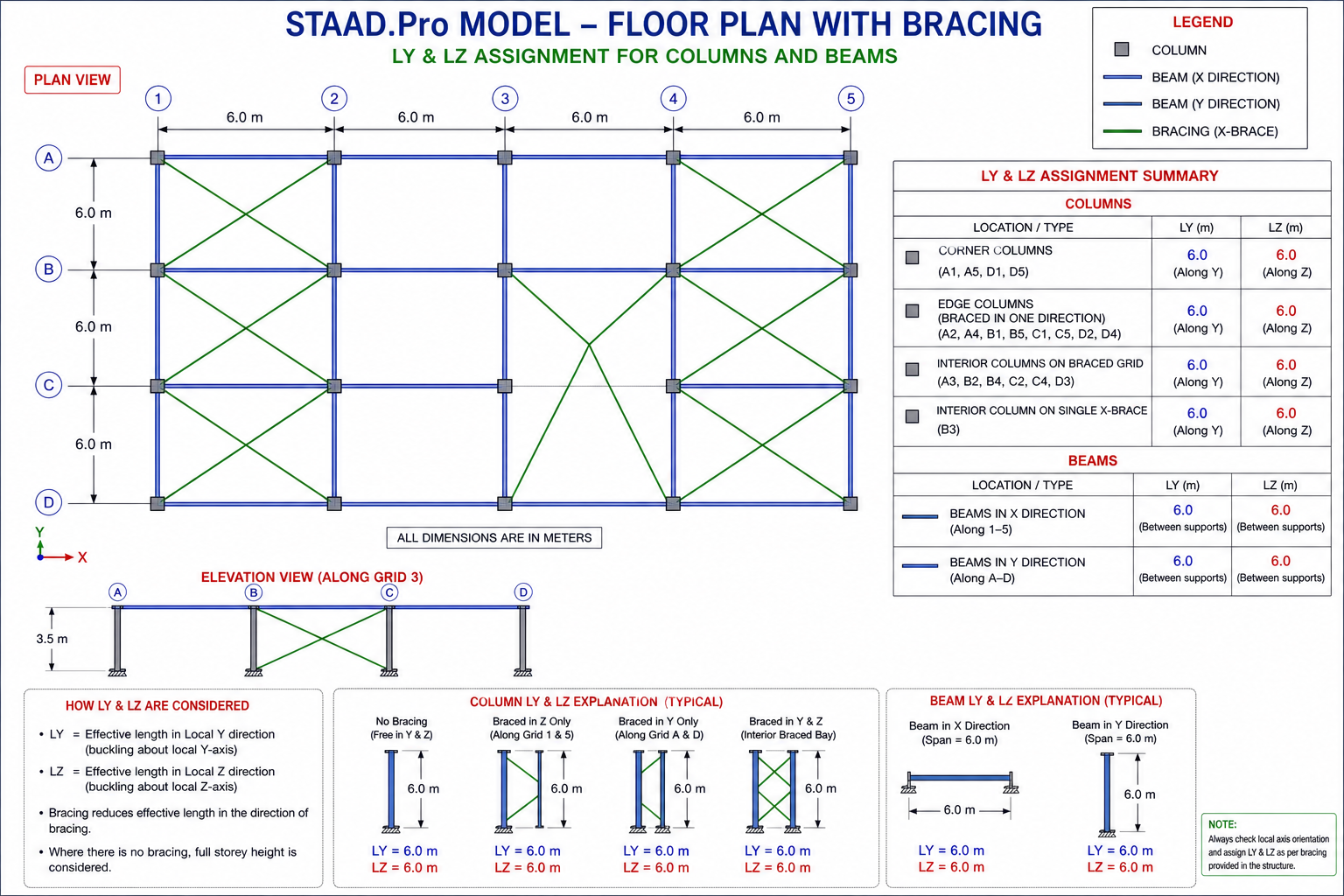
🔹 What is LY and LZ?
In STAAD.Pro:
- LY = Effective length of member about local Y-axis
- LZ = Effective length about local Z-axis
These define buckling length of steel members.


LY & LZ Assignment – Detailed Explanation (Based on Floor Plan with Bracing)
🔷 1. Understanding the Model in Your Image


From your diagram:
- Grid spacing = 6m × 6m
- Columns at all intersections (A–D, 1–5)
- Beams in both X & Y directions
- X-bracing provided in selected bays
- One interior bay has irregular bracing (central bay)
👉 This directly controls effective length (LY, LZ) of columns.
🔷 2. What Exactly LY & LZ Represent
| Parameter | Meaning | Controls |
|---|---|---|
| LY | Buckling length about local Y-axis | Weak axis buckling |
| LZ | Buckling length about local Z-axis | Strong axis buckling |
👉 Important:
- Columns buckle in both directions
- Bracing reduces length only in that direction
🔷 3. Key Rule from Your Plan
👉 Effective length = distance between lateral restraints (bracing points)
So:
- If NO bracing → full height considered
- If bracing exists → reduced length
🔷 4. COLUMN-WISE LY & LZ EXPLANATION
🔹 (A) Corner Columns (A1, A5, D1, D5)
Condition:
- Bracing connected through adjacent bays
- Restrained in both X & Z directions
Result:
- LY = 6m
- LZ = 6m
👉 Why?
- Bracing panels are directly connected → column cannot sway freely
🔹 (B) Edge Columns (Example: A2, B1, C5)
Condition:
- Bracing only in one adjacent bay
Behavior:
- One direction → restrained
- Other direction → partially free
👉 But in your plan:
- Since beam-column joints connect to braced bays
→ stiffness transfers
Practical STAAD assumption:
- LY = 6m
- LZ = 6m
👉 Conservative & standard practice for sheds
🔹 (C) Interior Columns in Braced Bays (A3, B2, C4, etc.)
Condition:
- Fully surrounded by braced panels
Behavior:
- Restrained in both directions
Result:
- LY = 6m
- LZ = 6m
👉 These are most stable columns
🔹 (D) Interior Column in Irregular Bracing (Center Bay)
Condition:
- Only one diagonal / non-uniform bracing
Behavior:
- Unequal stiffness
- One direction slightly flexible
👉 Still in practical modeling:
- LY = 6m
- LZ = 6m
But:
⚠️ Advanced design → reduce only in braced direction
🔷 5. WHY ALL VALUES ARE 6m IN YOUR IMAGE?
This is the most important concept 👇
👉 Your bracing is provided in plan (horizontal stability)
👉 But LY/LZ for columns depend on:
✔ Vertical restraint (storey-wise)
NOT just plan bracing
🔥 Critical Insight:
In your model:
- No intermediate bracing along column height
- Only one floor level
👉 Therefore:
Effective length = full column height = 6m
🔷 6. WHEN WILL LY / LZ REDUCE IN THIS PLAN?
If you modify model:
Case 1: Add mid-height bracing (say at 3m)
Then:
| Direction | Value |
|---|---|
| LY | 3m |
| LZ | 3m |
Case 2: Bracing only in X direction
| Direction | Value |
|---|---|
| LY | 6m |
| LZ | 3m |
🔷 7. BEAM LY & LZ IN YOUR PLAN
🔹 Beams in X-direction
- Span = 6m
- Connected column to column
👉 LY = 6m
👉 LZ = 6m
🔹 If purlins / slab exist
Then:
| Parameter | Value |
|---|---|
| LY | Reduced (spacing of purlins) |
| LZ | Full span |
🔷 8. STAAD INPUT (FOR YOUR MODEL)
You can include this in your blog:
PARAMETER 1
LY 6 ALL
LZ 6 ALL
👉 Or member-wise assignment:
LY 6 MEMB 1 TO 50
LZ 6 MEMB 1 TO 50
🔷 9. VISUAL LOGIC
Without Vertical Bracing:
- Column behaves like:
Free to buckle entire height
→ LY = Full height
→ LZ = Full height
With Vertical Bracing:
Column split into segments
→ Buckling length reduces
🔷 10. COMMON MISUNDERSTANDING (VERY IMPORTANT)
❌ “Bracing in plan reduces LY/LZ”
✔ WRONG
✅ Only bracing along column height reduces LY/LZ
🔷 11. PROFESSIONAL DESIGN TIP
For industrial structures:
- Always check:
- Local axis orientation
- Weak axis buckling
- Actual restraint condition
👉 In Structural Engineering:
Weak axis (LY) usually governs design
🔷 12. BLOG SUMMARY
In STAAD, LY and LZ represent the effective buckling length of columns in local Y and Z directions. In the given floor plan with bracing, although bracing is present in plan, it does not reduce the effective length unless intermediate vertical restraints are provided along the column height. Hence, LY and LZ are taken as full storey height (6m) for all columns.
- Circular Pipe Base Plate Design | AISC ASD Guide + PDF Download
 Introduction The base plate is one of the most important… Read more: Circular Pipe Base Plate Design | AISC ASD Guide + PDF Download
 - Australian Wind Load Calculator as per AS/NZS 1170.2:2021
 Australian Wind Load Calculator | AS/NZS 1170.2:2021 Australian Wind Load… Read more: Australian Wind Load Calculator as per AS/NZS 1170.2:2021
 - Wind Load Calculator as per IS 875 Part 3:2015
 Industrial Shed Wind Load Calculator | IS 875 Part 3:2015… Read more: Wind Load Calculator as per IS 875 Part 3:2015
 - How to Assign LY and LZ in STAAD for Steel Structures (With and Without Bracing)
 🔹 What is LY and LZ? In STAAD.Pro: These define… Read more: How to Assign LY and LZ in STAAD for Steel Structures (With and Without Bracing)
 - Expansion, Contraction and Construction Joints in Concrete for Civil Works
 1. Introduction Concrete is one of the most widely used… Read more: Expansion, Contraction and Construction Joints in Concrete for Civil Works
 - Cable Rack Structural Steel Detail and Design
 Introduction Cable racks (also called cable trays or cable support… Read more: Cable Rack Structural Steel Detail and Design
 - Repair Principles for Corrosion Damaged Reinforced Concrete Structures
 Reinforced concrete is one of the most widely used construction… Read more: Repair Principles for Corrosion Damaged Reinforced Concrete Structures
 - Civil Engineering Guide to Concrete Repair and Strengthening
 Concrete is one of the most widely used construction materials… Read more: Civil Engineering Guide to Concrete Repair and Strengthening
 - Australian Code Load Combinations
 (For Steel Structures & RCC Buildings) 1. Relevant Australian Standards… Read more: Australian Code Load Combinations
 - Eurocode Base Plate Calculator – EN 1993-1-8
 Introduction Base plates are critical components in steel structures, transferring… Read more: Eurocode Base Plate Calculator – EN 1993-1-8
 - Base Plate Design Calculation AS 4100
 Introduction In structural steel design, the base plate is a… Read more: Base Plate Design Calculation AS 4100
 - Base Plate Design Calculator CSA A23.3
 Introduction Steel column base plates transfer loads from the column… Read more: Base Plate Design Calculator CSA A23.3
 - Base Plate Design Calculator ACI 318
 Introduction Designing a steel column base plate is a critical… Read more: Base Plate Design Calculator ACI 318
 - Base Plate Design as per IS 800 2007
 Introduction (Anchor Bolts Outside & Inside Column Flange) Base plates… Read more: Base Plate Design as per IS 800 2007
 - Bar Bending Schedule | BBS Calculator For Beam Column and Slab
 Managing the Bar Bending Schedule (BBS) is one of the… Read more: Bar Bending Schedule | BBS Calculator For Beam Column and Slab
 - Room Paint Calculator | Paint, Primer & Putty Quantity & Cost Estimator
 Looking to renovate your room? Our Room Paint, Primer &… Read more: Room Paint Calculator | Paint, Primer & Putty Quantity & Cost Estimator
 - Load Conversion & Stress Calculator | kN to kg, ton, N, MPa Online
 Load Conversion & Stress Calculator for Civil and Structural Engineers… Read more: Load Conversion & Stress Calculator | kN to kg, ton, N, MPa Online
 - Water Tank Capacity Calculator – Feet & Meter Conversion (Litres & Gallons)
 Water Tank Capacity Calculator with Unit Conversion Accurate water storage… Read more: Water Tank Capacity Calculator – Feet & Meter Conversion (Litres & Gallons)
 - Brick Wall Construction Calculator | Calculate Bricks & Cost Instantly |
 Introduction Building a brick wall requires accurate planning to avoid… Read more: Brick Wall Construction Calculator | Calculate Bricks & Cost Instantly |
 - Unit Converter – Feet, Inches, cm, mm, Yard to Meter and Vice Versa
 Length Unit Converter 🌙 Toggle Dark Mode Length Unit Converter… Read more: Unit Converter – Feet, Inches, cm, mm, Yard to Meter and Vice Versa
 - Lifting Analysis of Skid Using Spreader Beam 4-Point
 COG Shift, Moment Calculation & Sling Forces for STAAD Pro… Read more: Lifting Analysis of Skid Using Spreader Beam 4-Point
 - Base Plate Design as per IS Code | IS 800:2007 Steel Column Base |
 Introduction In steel structures, the base plate is a critical… Read more: Base Plate Design as per IS Code | IS 800:2007 Steel Column Base |
 - Wind Load Calculation IS 875 Part 3 2015
 Below is a compact, practical guide you can use on… Read more: Wind Load Calculation IS 875 Part 3 2015
 - Road Turning Radius as per IS/IRC Codes and International Standards AASHTO BS/DMRB
 1. Turning Radius as per Indian Standards (IRC/IS Codes) In… Read more: Road Turning Radius as per IS/IRC Codes and International Standards AASHTO BS/DMRB
 - Foundation Design ACI 318 pdf & Excel Download
 In ACI 318 (American Concrete Institute’s Building Code Requirements for… Read more: Foundation Design ACI 318 pdf & Excel Download