
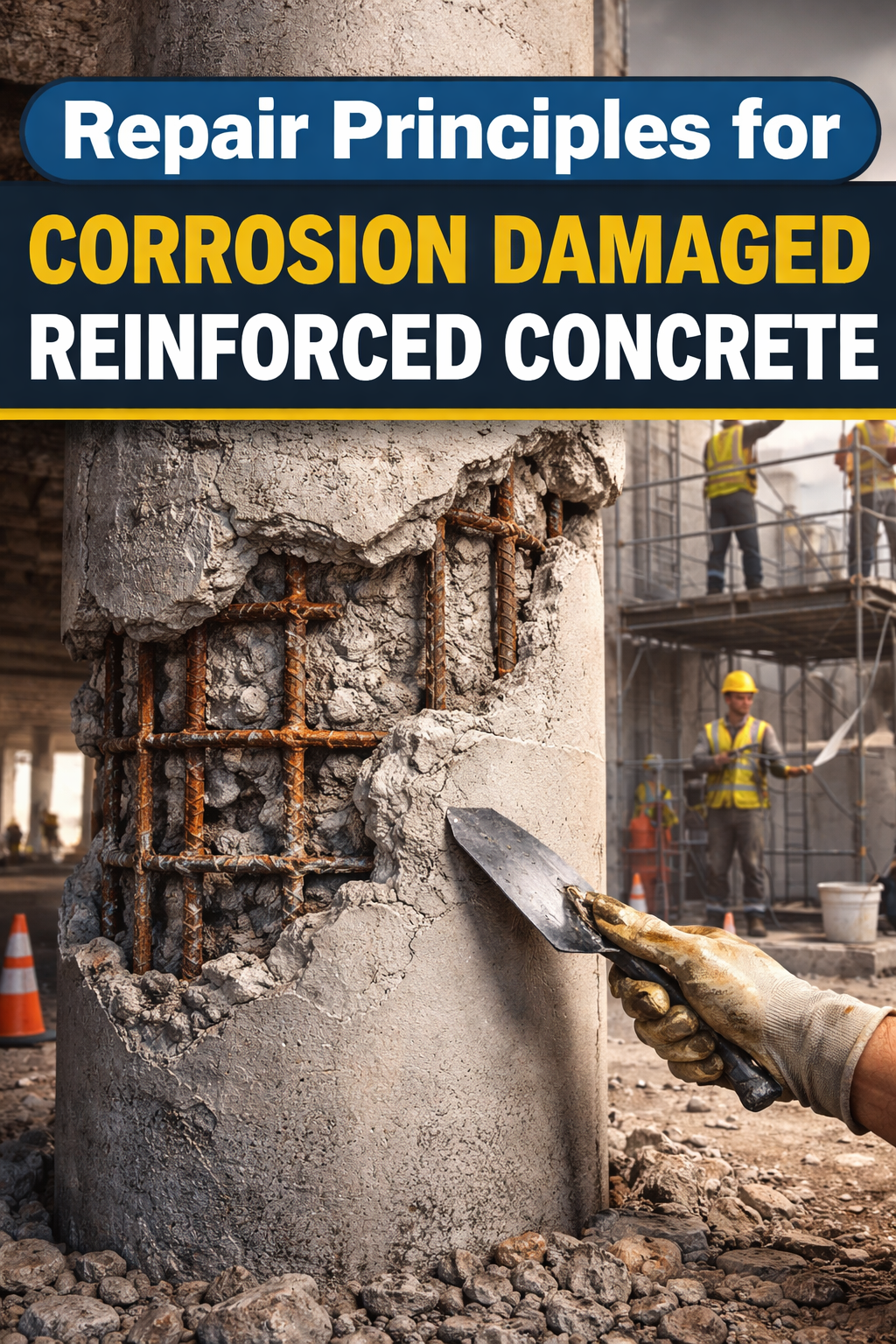
Reinforced concrete is one of the most widely used construction materials in civil engineering because of its strength, durability, and cost efficiency. However, over time many structures suffer deterioration due to corrosion of steel reinforcement embedded in concrete.
When reinforcement bars corrode, rust products expand up to 6–8 times the original steel volume, creating internal pressure inside the concrete. This pressure causes cracking, delamination, and spalling of the concrete cover, which eventually reduces the structural capacity of the member.

Concrete spalling showing rusted rebar and structural damage

Concrete spalling showing rusted rebar and structural damage

Cracked concrete surface with exposed rebar, showcasing weathered textures and structural damage, evokes sense of decay and neglect
Corrosion-damaged concrete structures are common in:
- Bridges and flyovers
- Marine structures and ports
- Parking garages
- Residential and commercial buildings
- Water retaining structures
Proper repair and rehabilitation methods can restore the strength, serviceability, and durability of the structure, extending its service life by several decades.
This article explains the repair principles, assessment techniques, materials, and practical procedures used in repairing corrosion-damaged reinforced concrete structures.
1. Understanding Corrosion in Reinforced Concrete
How Reinforcement Corrosion Occurs


Reinforcement bars in concrete normally remain protected because concrete has a high alkaline environment (pH 12.5–13). This alkalinity forms a passive protective film on the steel surface that prevents corrosion.
However, corrosion begins when this protective layer is destroyed due to environmental factors.
1. Carbonation
Carbon dioxide (CO₂) from the atmosphere penetrates concrete and reacts with calcium hydroxide in cement paste. This process reduces the alkalinity of concrete and lowers the pH.
When the pH drops below about 9.5, the protective layer around steel reinforcement breaks down, allowing corrosion to start.
Carbonation is more common in:
- Urban environments
- Old concrete structures
- Poorly compacted concrete
2. Chloride Attack
Chloride ions penetrate concrete and break the passive protective layer around reinforcement.
Common chloride sources include:
- Sea water exposure
- De-icing salts used on roads
- Contaminated construction materials
Chloride attack is a major durability issue in coastal structures and bridges.
3. Moisture and Oxygen
Corrosion is an electrochemical reaction that requires:
- Water
- Oxygen
- Electrolytes
Cracks in concrete allow water and oxygen to reach reinforcement, accelerating corrosion.
Visible Signs of Reinforcement Corrosion
Engineers usually identify corrosion damage through several symptoms:
- Rust stains on concrete surface
- Longitudinal cracks along reinforcement
- Spalling of concrete cover
- Delamination of concrete layers
- Exposed steel reinforcement
If not repaired early, corrosion can reduce the cross-section of reinforcement bars, weakening the structural element.
2. Inspection and Condition Assessment
Before any repair work begins, engineers must perform a detailed condition assessment of the structure. Proper investigation helps determine the extent of deterioration and the most suitable repair strategy.


1. Visual Inspection
Visual inspection is the first step in structural assessment. Engineers look for visible signs such as:
- surface cracks
- rust staining
- spalling or delaminated concrete
- exposed reinforcement
Mapping these defects helps identify critical zones requiring repair.
2. Rebound Hammer Test
The rebound hammer test measures the surface hardness of concrete, which indicates approximate compressive strength.
Low rebound values may indicate:
- deteriorated concrete
- poor concrete quality
- damaged surface layers
3. Half-Cell Potential Test
This electrochemical test measures the probability of corrosion in reinforcement bars.
Interpretation example:
- −200 mV → low probability of corrosion
- −350 mV → high probability of corrosion
This test is widely used in bridge inspection and structural rehabilitation projects.
4. Carbonation Depth Test
Engineers spray phenolphthalein indicator solution on freshly exposed concrete surfaces.
Results:
- Purple color → non-carbonated concrete
- No color change → carbonated concrete
If carbonation depth reaches reinforcement level, corrosion risk becomes high.
5. Chloride Content Test
Concrete powder samples are collected and tested to determine chloride concentration.
High chloride levels indicate severe corrosion potential.
3. Fundamental Principles of Concrete Repair
Successful repair of corrosion-damaged concrete structures must follow standard engineering principles.
The main objectives are:
- Stop ongoing corrosion
- Restore structural integrity
- Protect reinforcement from future corrosion
- Improve durability of repaired area
Repairs that only cover the damaged area without addressing corrosion causes often fail within a few years.
Key repair principles include:
Principle 1 – Remove Deteriorated Concrete
All loose, cracked, and contaminated concrete must be removed to expose sound substrate.
Principle 2 – Restore Reinforcement Protection
Steel reinforcement must be cleaned and protected using anti-corrosion treatments.
Principle 3 – Rebuild Structural Capacity
Repair materials must provide adequate strength to restore the original structural capacity.
Principle 4 – Prevent Future Deterioration
Protective coatings and waterproofing systems should be applied to prevent further environmental damage.
4. Concrete Removal and Surface Preparation


Surface preparation is one of the most critical steps in concrete repair.
Poor surface preparation often leads to repair failure and debonding of repair materials.
Concrete Removal Methods
Several methods are used to remove deteriorated concrete:
- Mechanical Chipping
Using jackhammers or chipping hammers to remove damaged concrete.
- Hydro-Demolition
High-pressure water jets remove weak concrete while preserving sound concrete and reinforcement.
- Grinding and Scarifying
Used for removing thin surface layers.
Requirements for Proper Preparation
- Remove all unsound concrete
- Expose reinforcement completely
- Provide clearance around bars (20–25 mm)
- Roughen concrete surface for better bonding
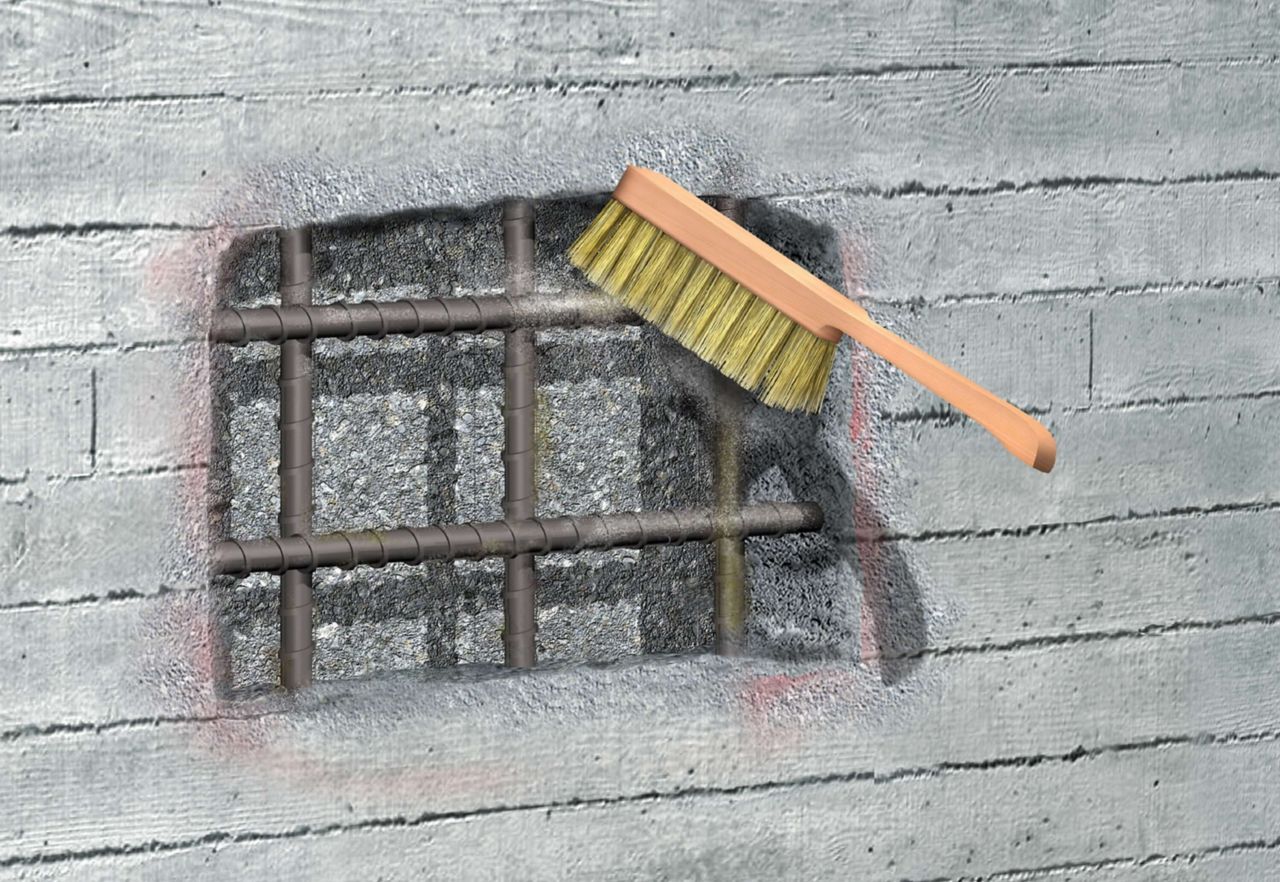
After concrete removal, reinforcement bars must be cleaned to remove corrosion products.
5. Reinforcement Treatment and Protection


Once reinforcement is exposed, it must be cleaned and treated properly.
Cleaning Reinforcement
Methods used include:
- Wire brushing
- Sand blasting
- High-pressure water jetting
The aim is to remove rust, mill scale, and contaminants.
Reinforcement Loss Evaluation
If corrosion has significantly reduced bar diameter:
- Additional reinforcement must be provided
- Steel bars may be welded or anchored
Anti-Corrosion Protection
After cleaning, protective coatings are applied to prevent future corrosion.
Common products include:
- Zinc-rich primers
- Epoxy coatings
- Polymer cement slurry coatings
These coatings act as a barrier between steel and moisture or oxygen.
Cathodic Protection Systems
For severe corrosion problems, cathodic protection systems may be installed.
These systems control corrosion by applying a small electrical current to reinforcement, preventing electrochemical corrosion reactions.
6. Bonding Agents for Concrete Repair
Repair materials must bond strongly with the existing concrete.
Bonding agents help achieve high adhesion and structural integrity.
Common bonding materials include:
Cement Slurry
A simple mixture of cement and water applied to the prepared surface before repair mortar placement.
Polymer Bonding Agents
Examples include:
- SBR latex
- Acrylic bonding agents
Advantages include:
- Increased bond strength
- Reduced permeability
- Improved durability
Bonding agents ensure that the old concrete and new repair material act as a single structural unit.
7. Repair Materials Used


4
Various repair materials are available depending on repair depth, structural requirements, and environmental conditions.
Polymer Modified Mortar (PMM)
Used for shallow repairs (10–50 mm thickness).
Advantages:
- High bond strength
- Reduced shrinkage
- Low permeability
Micro Concrete
Micro concrete is used for deep structural repairs.
Properties:
- Self-compacting
- High strength
- Non-shrink
It is commonly used for repairing columns, beams, and bridge elements.
Non-Shrink Grout
Used where precision filling and structural anchoring are required.
Shotcrete
Shotcrete is sprayed concrete used for large repair areas.
Applications include:
- bridge rehabilitation
- tunnel repair
- retaining wall strengthening
8. Surface Protection Systems


4
After repair completion, protective coatings are applied to prevent further deterioration.
Anti-Carbonation Coatings
Prevent carbon dioxide penetration into concrete.
Silane / Siloxane Coatings
These provide water repellency while allowing vapor diffusion.
Elastomeric Waterproof Coatings
Used in structures exposed to:
- heavy rainfall
- water leakage
Epoxy Coatings
Used in industrial environments where chemical resistance is required.
9. Quality Control During Repair
Proper quality control ensures long-term durability of repair work.
Important quality checks include:
- Surface preparation inspection
- Reinforcement cleaning verification
- Repair material mix control
- Bond strength testing
- Compressive strength testing
Curing of Repair Materials
Curing is essential for achieving required strength.
Methods include:
- Water curing
- Wet coverings
- Curing compounds
Proper curing significantly improves durability and crack resistance.
Conclusion
Corrosion of reinforcement is one of the most serious durability problems in reinforced concrete structures. If not addressed properly, it can lead to severe structural deterioration and costly reconstruction.
Effective repair requires:
- Proper condition assessment
- Removal of deteriorated concrete
- Reinforcement cleaning and protection
- Use of suitable repair materials
- Application of protective coatings
By following correct repair principles and modern rehabilitation techniques, engineers can extend the service life of concrete structures by 20–40 years or more.
- Repair Principles for Corrosion Damaged Reinforced Concrete Structures
 Reinforced concrete is one of the most widely used construction… Read more: Repair Principles for Corrosion Damaged Reinforced Concrete Structures
 - Civil Engineering Guide to Concrete Repair and Strengthening
 Concrete is one of the most widely used construction materials… Read more: Civil Engineering Guide to Concrete Repair and Strengthening
 - Australian Code Load Combinations
 (For Steel Structures & RCC Buildings) 1. Relevant Australian Standards… Read more: Australian Code Load Combinations
 - Eurocode Base Plate Calculator – EN 1993-1-8
 Introduction Base plates are critical components in steel structures, transferring… Read more: Eurocode Base Plate Calculator – EN 1993-1-8
 - Base Plate Design Calculation AS 4100
 Introduction In structural steel design, the base plate is a… Read more: Base Plate Design Calculation AS 4100
 - Base Plate Design Calculator CSA A23.3
 Introduction Steel column base plates transfer loads from the column… Read more: Base Plate Design Calculator CSA A23.3
 - Base Plate Design Calculator ACI 318
 Introduction Designing a steel column base plate is a critical… Read more: Base Plate Design Calculator ACI 318
 - Base Plate Design as per IS 800 2007
 Introduction (Anchor Bolts Outside & Inside Column Flange) Base plates… Read more: Base Plate Design as per IS 800 2007
 - Bar Bending Schedule | BBS Calculator For Beam Column and Slab
 Managing the Bar Bending Schedule (BBS) is one of the… Read more: Bar Bending Schedule | BBS Calculator For Beam Column and Slab
 - Room Paint Calculator | Paint, Primer & Putty Quantity & Cost Estimator
 Looking to renovate your room? Our Room Paint, Primer &… Read more: Room Paint Calculator | Paint, Primer & Putty Quantity & Cost Estimator
 - Load Conversion & Stress Calculator | kN to kg, ton, N, MPa Online
 Load Conversion & Stress Calculator for Civil and Structural Engineers… Read more: Load Conversion & Stress Calculator | kN to kg, ton, N, MPa Online
 - Water Tank Capacity Calculator – Feet & Meter Conversion (Litres & Gallons)
 Water Tank Capacity Calculator with Unit Conversion Accurate water storage… Read more: Water Tank Capacity Calculator – Feet & Meter Conversion (Litres & Gallons)
 - Brick Wall Construction Calculator | Calculate Bricks & Cost Instantly |
 Introduction Building a brick wall requires accurate planning to avoid… Read more: Brick Wall Construction Calculator | Calculate Bricks & Cost Instantly |
 - Unit Converter – Feet, Inches, cm, mm, Yard to Meter and Vice Versa
 Length Unit Converter 🌙 Toggle Dark Mode Length Unit Converter… Read more: Unit Converter – Feet, Inches, cm, mm, Yard to Meter and Vice Versa
 - Lifting Analysis of Skid Using Spreader Beam 4-Point
 COG Shift, Moment Calculation & Sling Forces for STAAD Pro… Read more: Lifting Analysis of Skid Using Spreader Beam 4-Point
 - Base Plate Design as per IS Code | IS 800:2007 Steel Column Base |
 Introduction In steel structures, the base plate is a critical… Read more: Base Plate Design as per IS Code | IS 800:2007 Steel Column Base |
 - Wind Load Calculation IS 875 Part 3 2015
 Below is a compact, practical guide you can use on… Read more: Wind Load Calculation IS 875 Part 3 2015
 - Road Turning Radius as per IS/IRC Codes and International Standards AASHTO BS/DMRB
 1. Turning Radius as per Indian Standards (IRC/IS Codes) In… Read more: Road Turning Radius as per IS/IRC Codes and International Standards AASHTO BS/DMRB
 - Foundation Design ACI 318 pdf & Excel Download
 In ACI 318 (American Concrete Institute’s Building Code Requirements for… Read more: Foundation Design ACI 318 pdf & Excel Download
 - Design of Steel Silo
 1. Introduction Steel silo is, typical uses (grain, cement, powders),… Read more: Design of Steel Silo
 - Design of Beam to Beam End Plate Connection
 Beam end-to-end connections (splices) ensure continuity and safe transfer of… Read more: Design of Beam to Beam End Plate Connection
 - DESIGN OF FLAT SLAB pdf Free Download
 🔹 What is a Flat Slab? A flat slab is… Read more: DESIGN OF FLAT SLAB pdf Free Download
 - Design of Thrust Block
 Thrust blocks are one of the most important structural components… Read more: Design of Thrust Block
 - DESIGN OF BARREL FOR BOX CULVERT pdf Free Download
 Box culvert design according to IRC 6 (Standard Specifications and Code… Read more: DESIGN OF BARREL FOR BOX CULVERT pdf Free Download
 - Design of Retaining Wall Calculation pdf Free Download
 Retaining walls are essential structural elements in civil engineering, used… Read more: Design of Retaining Wall Calculation pdf Free Download
 - Analysis and Design of Drain Sump Pit
 Introduction A sump pit, commonly used in buildings, industrial plants,… Read more: Analysis and Design of Drain Sump Pit
 - Design of Steel Shelter as per IS 800
 Designing a steel shelter requires a clear understanding of structural… Read more: Design of Steel Shelter as per IS 800
 - Octagonal Pedestal Design
 Designing an octagon pedestal as per ACI (American Concrete Institute)… Read more: Octagonal Pedestal Design
 - Ring Wall Foundation Design
 ✅ Overview A Ring Wall Foundation is a circular or… Read more: Ring Wall Foundation Design
 - Decking Sheet with Concrete – Design Details & Specifications
 Overview Decking sheets, also known as composite metal decks or… Read more: Decking Sheet with Concrete – Design Details & Specifications
 - Hydrodynamic Load on Tanks | Convective and Impulsive |
 Hydrodynamic loads for tanks refer to the forces exerted on… Read more: Hydrodynamic Load on Tanks | Convective and Impulsive |
 - PILE STIFFNESS CALCULATION
 STAAD INPUT FOR SUPPORT CONDITION VERTICAL STIFFNESSAllowable vertical settlement =… Read more: PILE STIFFNESS CALCULATION
 - Concrete Beam Design ACI 318
 Concrete beams are essential structural components in reinforced concrete construction,… Read more: Concrete Beam Design ACI 318
 - Floor Slab Design One Way as per ACI 318
 One-way slabs are one of the most commonly used structural… Read more: Floor Slab Design One Way as per ACI 318
 - Floor Slab Design Two way as per ACI 318
 Two-way floor slabs are the backbone of most modern reinforced… Read more: Floor Slab Design Two way as per ACI 318
Leave a Reply