
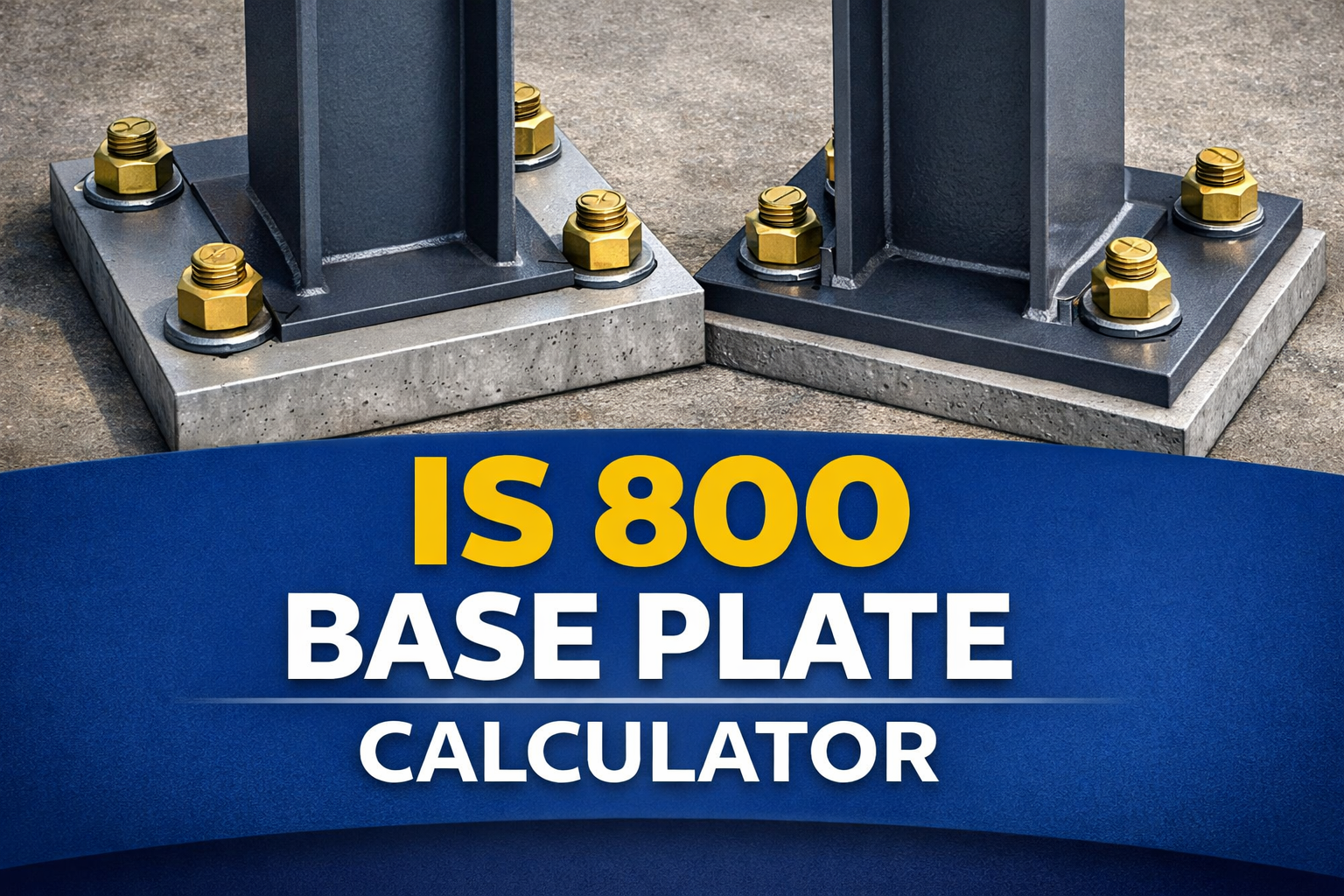
Introduction (Anchor Bolts Outside & Inside Column Flange)
Base plates are critical steel connection elements used to safely transfer axial load, bending moment, and shear force from a steel column to the concrete foundation.
As per IS 800:2007 – General Construction in Steel, base plate design ensures adequate bearing, bending resistance, and anchorage safety.
This article explains the step-by-step design of a base plate with anchor bolts located outside the column flange, which is commonly adopted for heavily loaded columns and moment-resisting frames.
Base Plate Design Calculator (IS 800:2007)
Preliminary design of steel column base plates with anchor bolts inside or outside column flange.
Input Parameters
Detailed Design Calculations (Auto-Generated)
How This Sheet Works
q = Pu / (L × B)
Permissible qallow = 0.45 fck
Ref: IS 800:2007 Clause 7.4.1–7.4.3
Step 2: Effect of Bending Moment
qmax = q + Mu / Z , qmin = q − Mu / Z
Z = L·B²/6
Ref: IS 800:2007 Clause 7.4.1
Step 3: Plate Thickness
M = qmax·a²/2 , t = √(6M/fy)
Ref: IS 800:2007 Clause 8.2.1.2
Step 4: Anchor Bolt Tension
Tb = Mu / (n·y)
Ref: IS 800:2007 Clause 7.4.4
Step 5: Auto Plate Size Suggestion
If qmax > qallow → Areq = Pu/qallow, suggest square plate.
Base Plate Plan & Section (Indicative)
Note: Preliminary design only. Check shear, welds, bolt capacity, edge distances per IS 800/IS 456.
⚠️ Engineering Disclaimer
This calculator is for preliminary design and educational use only. Final design must be verified by a qualified structural engineer as per IS 800:2007 and relevant codes.Design References (IS Codes)
- IS 800:2007 – Steel design
- IS 456:2000 – Concrete design
- IS 5624 / IS 1367 – Anchor bolts
- SP 6(1) – Steel tables
Typical Arrangement – Bolts Outside Flange
In this configuration:
- Anchor bolts are placed outside the column section
- Provides higher lever arm
- Improves moment resistance
- Easier tightening and inspection
Commonly used for:
- Portal frames
- Industrial buildings
- High axial load + moment columns
Given Design Data (Typical)
- Factored axial load, Pu
- Factored moment, Mu
- Column section (e.g., ISHB / ISMB)
- Concrete grade (M20 / M25)
- Plate material (Fe 250 / Fe 410)
- Bolt grade (4.6 / 8.8)
Step 1: Base Plate Area from Bearing Pressure
Design Bearing Strength of Concrete
As per IS 800:2007, Cl. 7.4.3:σbr=0.45fckA2A1≤0.9fck
Where:
- A1 = supporting concrete area
- A2 = loaded area (base plate)
Required Base Plate Area
Ap=σbrPu
Select plate length (L) and width (B) such that bearing pressure is within limit.
Step 2: Pressure Distribution Under Base Plate
For axial load + bending moment, pressure varies linearly.
Maximum Pressure:
qmax=ApPu+ZpMu
Minimum Pressure:
qmin=ApPu−ZpMu
Ensure qmin ≥ 0 (no uplift)
If uplift occurs → anchor bolts take tension
Step 3: Anchor Bolt Tension (Bolts Outside Flange)
When uplift is present:Tb=∑(n×y)Mu−Pu×e
Where:
- Tb = tension per bolt
- n = number of bolts
- y = distance of bolt from plate centroid
Bolt Capacity Check
Tdb=0.9fubAn/γmb
Ensure:Tb≤Tdb
Step 4: Base Plate Thickness Design
Plate behaves as a cantilever projection beyond column face.
Bending Moment per unit width:
M=qmax×a2/2
Required Plate Thickness:
t=fy6M
Where:
- a = projection beyond column
- fy = yield strength of plate
Adopt next higher standard thickness (e.g., 20 mm, 25 mm).
Step 5: Weld Design (Column to Plate)
- Continuous fillet weld
- Weld force = column load transfer
- As per IS 800:2007, Cl. 10
Pw=0.7slfwd
Where:
- s = weld size
- l = effective length
Step 6: Shear Resistance
Shear is resisted by:
- Friction between plate & concrete
- Anchor bolts (if required)
Vd=μPu
If inadequate → design shear key or bolts in shear.
Advantages of Bolts Outside Column Flange
✅ Higher moment resistance
✅ Reduced bolt tension
✅ Better constructability
✅ Suitable for seismic & crane loads
Common Detailing Requirements
- Minimum edge distance ≥ 1.5 × bolt dia
- Washer plates under nuts
- Grout thickness: 25–50 mm
- Bolt projection ≥ 2 threads
Conclusion
Base plate design as per IS 800:2007 with anchor bolts outside the column flange is an efficient and safe solution for heavily loaded steel columns. Proper checks for bearing, bending, bolt tension, welds, and shear ensure long-term performance and code compliance.
This configuration is widely recommended for industrial buildings, portal frames, and moment-resisting structures.
- Catch Basin Types and Details
 Catch basins are essential components of stormwater management systems. They… Read more: Catch Basin Types and Details
 - Eurocode Base Plate Calculator – EN 1993-1-8
 Introduction Base plates are critical components in steel structures, transferring… Read more: Eurocode Base Plate Calculator – EN 1993-1-8
 - Base Plate Design Calculation AS 4100
 Introduction In structural steel design, the base plate is a… Read more: Base Plate Design Calculation AS 4100
 - Base Plate Design Calculator CSA A23.3
 Introduction Steel column base plates transfer loads from the column… Read more: Base Plate Design Calculator CSA A23.3
 - Base Plate Design Calculator ACI 318
 Introduction Designing a steel column base plate is a critical… Read more: Base Plate Design Calculator ACI 318
 - Base Plate Design as per IS 800 2007
 Introduction (Anchor Bolts Outside & Inside Column Flange) Base plates… Read more: Base Plate Design as per IS 800 2007
 - East Facing 38×56 House Plan – Ground & First Floor Design with 3BHK + Home Theatre
 An east-facing house is considered highly auspicious in Vastu Shastra,… Read more: East Facing 38×56 House Plan – Ground & First Floor Design with 3BHK + Home Theatre
 - Foundation Detail Drawings for Buildings With CAD Files
 A Practical Structural Drawing Guide Introduction Footing drawings form the… Read more: Foundation Detail Drawings for Buildings With CAD Files
 - Bar Bending Schedule | BBS Calculator For Beam Column and Slab
 Managing the Bar Bending Schedule (BBS) is one of the… Read more: Bar Bending Schedule | BBS Calculator For Beam Column and Slab
 - Room Paint Calculator | Paint, Primer & Putty Quantity & Cost Estimator
 Looking to renovate your room? Our Room Paint, Primer &… Read more: Room Paint Calculator | Paint, Primer & Putty Quantity & Cost Estimator
 - Load Conversion & Stress Calculator | kN to kg, ton, N, MPa Online
 Load Conversion & Stress Calculator for Civil and Structural Engineers… Read more: Load Conversion & Stress Calculator | kN to kg, ton, N, MPa Online
 - Water Tank Capacity Calculator – Feet & Meter Conversion (Litres & Gallons)
 Water Tank Capacity Calculator with Unit Conversion Accurate water storage… Read more: Water Tank Capacity Calculator – Feet & Meter Conversion (Litres & Gallons)
 - Brick Wall Construction Calculator | Calculate Bricks & Cost Instantly |
 Introduction Building a brick wall requires accurate planning to avoid… Read more: Brick Wall Construction Calculator | Calculate Bricks & Cost Instantly |
 - Unit Converter – Feet, Inches, cm, mm, Yard to Meter and Vice Versa
 Length Unit Converter 🌙 Toggle Dark Mode Length Unit Converter… Read more: Unit Converter – Feet, Inches, cm, mm, Yard to Meter and Vice Versa
 - Lifting Analysis of Skid Using Spreader Beam 4-Point
 COG Shift, Moment Calculation & Sling Forces for STAAD Pro… Read more: Lifting Analysis of Skid Using Spreader Beam 4-Point
 - Base Plate Design as per IS Code | IS 800:2007 Steel Column Base |
 Introduction In steel structures, the base plate is a critical… Read more: Base Plate Design as per IS Code | IS 800:2007 Steel Column Base |
 - Laser Cut Railing Price in India 2025 | MS & SS CNC Balcony DesignsPRICING COMPARISON CHART – MS vs SS vs LASER CUT… Read more: Laser Cut Railing Price in India 2025 | MS & SS CNC Balcony Designs
- MS Balcony Railing Price in India 2026 | Mild Steel Railing Works |
 Mild Steel (MS) balcony railings are one of the most… Read more: MS Balcony Railing Price in India 2026 | Mild Steel Railing Works |
 - Stainless Steel with Glass Handrail Price 2026
 Modern architecture puts a lot of emphasis on clean lines,… Read more: Stainless Steel with Glass Handrail Price 2026
 - Modern Duplex House West Facing 36 x 48
 Many people believe west-facing houses are not good, but according… Read more: Modern Duplex House West Facing 36 x 48
 - Pooja Room Door Design
 A pooja room is a sacred space in every Indian… Read more: Pooja Room Door Design
 - Modern House 3D Design – Visualizing Your Dream Home
 Modern 3D renderings bring contemporary house designs to life with… Read more: Modern House 3D Design – Visualizing Your Dream Home
 - Balcony Railing Designs for Modern Homes
 A balcony is more than just an outdoor extension —… Read more: Balcony Railing Designs for Modern Homes
 - Civil Engineering Interview Questions and Important Practical Foundation
 1. What factors affect the selection of foundation type? Soil… Read more: Civil Engineering Interview Questions and Important Practical Foundation
 - Wind Load Calculation IS 875 Part 3 2015
 Below is a compact, practical guide you can use on… Read more: Wind Load Calculation IS 875 Part 3 2015
Rain Water Gutter and Down Take Systems
Canadian Code Seismic Calculation Example
DESIGN OF FLAT SLAB pdf Free Download
Best 3D House Elevation Design G+1
Base Plate Design as per IS Code | IS 800:2007 Steel Column Base |
LOAD COMBINATIONS NBCC 2023
Electrical Layout For Residential Building
DESIGN OF SLABS AS PER IS456
WEST FACING HOUSE PLAN 50 x 40 | DUPLEX TYPE |
DESIGN OF PIPERACK STRUCTURE
Posted by
in
Leave a Reply