
1. What factors affect the selection of foundation type?
Soil bearing capacity, load magnitude, groundwater level, settlement criteria, depth of weak soil, structure type, and cost.
2. What is a Raft Foundation and when is it used?
A large concrete slab supporting multiple columns and walls, used when soil bearing capacity is low or differential settlement is expected.
3. What is Pile Foundation?
A deep foundation system transmitting loads to deeper, stronger soil strata when the upper soil is weak.
4. Types of piles?
End-bearing piles, friction piles, tension piles, compaction piles, micro-piles, and sheet piles.
5. What is Pile Load Test?
A field test performed to verify pile load capacity and measure settlement under incremental loading (static or dynamic).
6. Explain the difference between Bored Pile and Driven Pile.
Bored pile—constructed by drilling and casting concrete in situ; low vibration.
Driven pile—hammered into ground using pile driver; high vibration but consistent quality.
7. What is Skin Friction in piles?
The frictional resistance developed along the pile shaft that helps support loads.
8. What is Pile Integrity Test (PIT)?
A non-destructive test to check pile continuity, length, and detect cracks or voids.
9. What causes Pile Failure?
Weak toe strata, inadequate reinforcement, improper concreting, insufficient length, negative skin friction, or poor quality control.
10. What is Group Pile Effect?
Reduction of load capacity in closely spaced piles due to overlapping stress zones around each pile.
11. What is Settlement of Foundation?
Vertical downward movement under load caused by compression of soil layers.
12. Types of settlement?
Immediate settlement, primary consolidation settlement, secondary settlement.
13. What is Safe Bearing Capacity?
Allowable load per unit area after applying a factor of safety against ultimate failure.
14. How do you reduce foundation settlement?
Preloading, soil stabilization, stone columns, raft foundation, piles, or compaction.
15. What is Underpinning?
Strengthening an existing foundation by extending its depth or width to transfer load to more stable ground.
16. What is Groundwater Control during excavation?
Lowering or controlling water levels using well-point, deep wells, cut-off walls, or drainage systems to prevent collapse.
17. What is a Caisson Foundation?
A large watertight chamber sunk into riverbeds or deep soil layers to support bridge piers and heavy structures.
18. What is a Cut-off Wall?
Barrier used to prevent groundwater flow into excavations, typically made of secant piles, sheet piles, or diaphragm walls.
19. What is Lateral Earth Pressure?
Pressure exerted by soil on retaining structures; active, passive, and at-rest pressures must be considered.
20. What is a Mat Foundation Punching Shear?
Local failure around column supports when high loads exceed slab thickness capacity requires shear reinforcement or thickening of slab.
1. What is structural design?
The process of determining the strength, dimensions, and reinforcement required for a structure to safely resist applied loads.
2. What are the main types of loads in structural design?
Dead load, live load, wind load, seismic load, impact load, and snow load.
3. What is dead load?
The self-weight of the structure and all permanently attached components.
4. What is live load?
The load due to occupancy, movement, or temporary objects such as people and furniture.


5. What is factor of safety (FOS)?
A ratio that ensures structural safety by considering uncertainties in loads and material strengths.
6. What is modulus of elasticity of concrete?
The ratio of stress to strain in the linear portion of the stress-strain curve (approx. 5000√fck in MPa).
7. What is Poisson’s ratio for concrete and steel?
Concrete: 0.15 – 0.20
Steel: 0.25 – 0.30
8. What is creep in concrete?
The long-term deformation of concrete under sustained load.
9. What is shrinkage in concrete?
Reduction in concrete volume due to loss of moisture during drying or hydration.
10. What is neutral axis in a beam?
An imaginary line in the cross-section where the bending stress is zero during flexure.
11. What is shear reinforcement?
Reinforcement (stirrups or links) provided in beams to resist diagonal shear stresses.
12. What is anchorage length?
The minimum embedded length of reinforcement required to develop full bond strength with concrete.
13. What is the difference between one-way and two-way slabs?
i. One-way slab: Reinforcement provided in one direction.
ii. Two-way slab: Reinforcement provided in both directions.
14. What is deflection in structural members?
The vertical displacement of a beam or slab under loading.
15. What are the limits of deflection as per design codes?
For beams and slabs:
i. Span/250 for total deflection
ii. Span/350 for live load deflection only
OP CIVIL ENGINEERING INTERVIEW QUESTIONS AND ANSWERS
1. What is Slump Test?
A field test used to measure the workability of fresh concrete by observing its subsidence after removing a cone mold.
2. Define Modulus of Elasticity.
It’s the ratio of stress to strain within the elastic limit of a material.
3. What is a Retaining Wall?
A structure designed to resist lateral earth pressure and hold back soil or rock from a slope.
4. What are Expansion Joints?
Gaps provided in concrete or masonry structures to allow expansion and contraction due to temperature changes.
5. What is Grouting?
The process of injecting cement slurry or chemical compounds into voids or cracks to strengthen or seal the structure.
6. Define Compaction Factor Test.
A laboratory test used to determine the degree of workability of concrete of low to medium consistency.
7. What is Honeycombing in Concrete?
Formation of voids or air pockets due to improper compaction during concrete placement.
8. Define Camber in Road Design.
A cross slope provided to facilitate drainage of surface water from the pavement.
9. What is Differential Settlement?
Uneven settlement of a structure’s foundation causing cracks or structural distress.
10. Define Lapping in Reinforcement.
The overlapping of steel bars to achieve the required design length when the bar is shorter than needed.
11. What is a Raft Foundation?
A large slab foundation that supports multiple columns and walls to distribute loads evenly over weak soil.
12. Define Shrinkage in Concrete.
Reduction in concrete volume due to water loss, leading to surface cracking.
13. What is a Plinth Beam?
A reinforced concrete beam provided between the foundation and walls to prevent differential settlement.
14. Define Pavement Layers.
The different structural components of a road are subgrade, sub-base, base, and surface course.
15. What is the Function of DPC (Damp Proof Course)?
A barrier layer that prevents moisture from rising through walls or floors by capillary action.
Practical Civil Engineering Interview Questions, Material Testing & Quality Control (Building & Highway Works – Practical & Technical)
1. Why is material testing important in construction?
To ensure that materials meet design specifications, standards, and safety requirements before and during use.
2. What tests are carried out on cement at site level?
Fineness test, setting time test, soundness test, and compressive strength test.
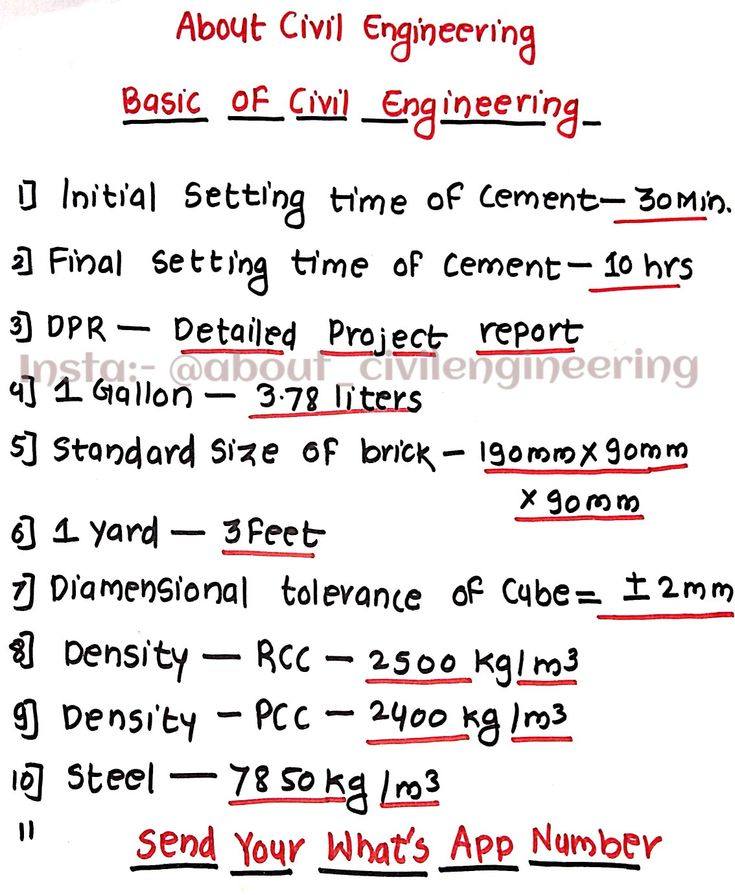
3. What is the standard initial and final setting time of OPC cement?
Initial setting time ≥ 30 minutes
Final setting time ≤ 600 minutes.
4. How do you check the quality of sand before use?
Silt content test, bulking test, sieve analysis (gradation), and visual inspection for organic matter.
5. What is the permissible silt content in fine aggregate?
Not more than 6% by volume.
6. What field tests are conducted on coarse aggregate?
Sieve analysis, impact value test, crushing value test, abrasion test, and flakiness & elongation index.
7. What is the standard slump range for different concrete works?
Footings: 25–75 mm
Beams & slabs: 75–100 mm
Pumped concrete: 100–150 mm.
8. How do you conduct a slump test on site?
Fill cone in 3 layers, each tamped 25 times, lift cone vertically, and measure subsidence.
9. What is cube test in concrete?
A compressive strength test carried out on 150 mm concrete cubes at 7 and 28 days.
10. What is the minimum acceptable strength at 7 days?
Generally ≥ 65% of the characteristic 28-day strength.
11. How many concrete cubes are required for each pour?
Minimum 3 cubes per 30 m³ of concrete or per day’s pour, whichever is higher.
12. What is field density test and where is it used?
It determines in-situ soil compaction using Sand Cone or Nuclear Density Method for earthworks.
13. What is the required compaction for subgrade and sub-base?
95–98% of Maximum Dry Density (MDD).
14. What tests are performed on asphalt materials?
Bitumen penetration test, softening point, ductility, Marshall stability, and core density test.
15. What is Marshall Stability Test?
A test to evaluate the strength, flow, and durability of asphalt mixes.
16. What is calibration in construction equipment?
Verification and adjustment of measuring devices to ensure accurate readings (weigh bridge, batching plant, testing machines).
17. What is a Method Statement?
A documented procedure describing how a specific construction activity will be executed safely and correctly.
18. What is an Inspection & Test Plan (ITP)?
A quality document outlining inspection stages, hold points, and acceptance criteria for each work activity.
19. What are non-destructive tests (NDT) in concrete?
Rebound hammer test, ultrasonic pulse velocity (UPV), and core cutting (semi-destructive).
20. What QA/QC records must be maintained on site?
Material approvals, test reports, cube results, field density reports, calibration certificates, ITPs, method statements, and daily QA logs.