
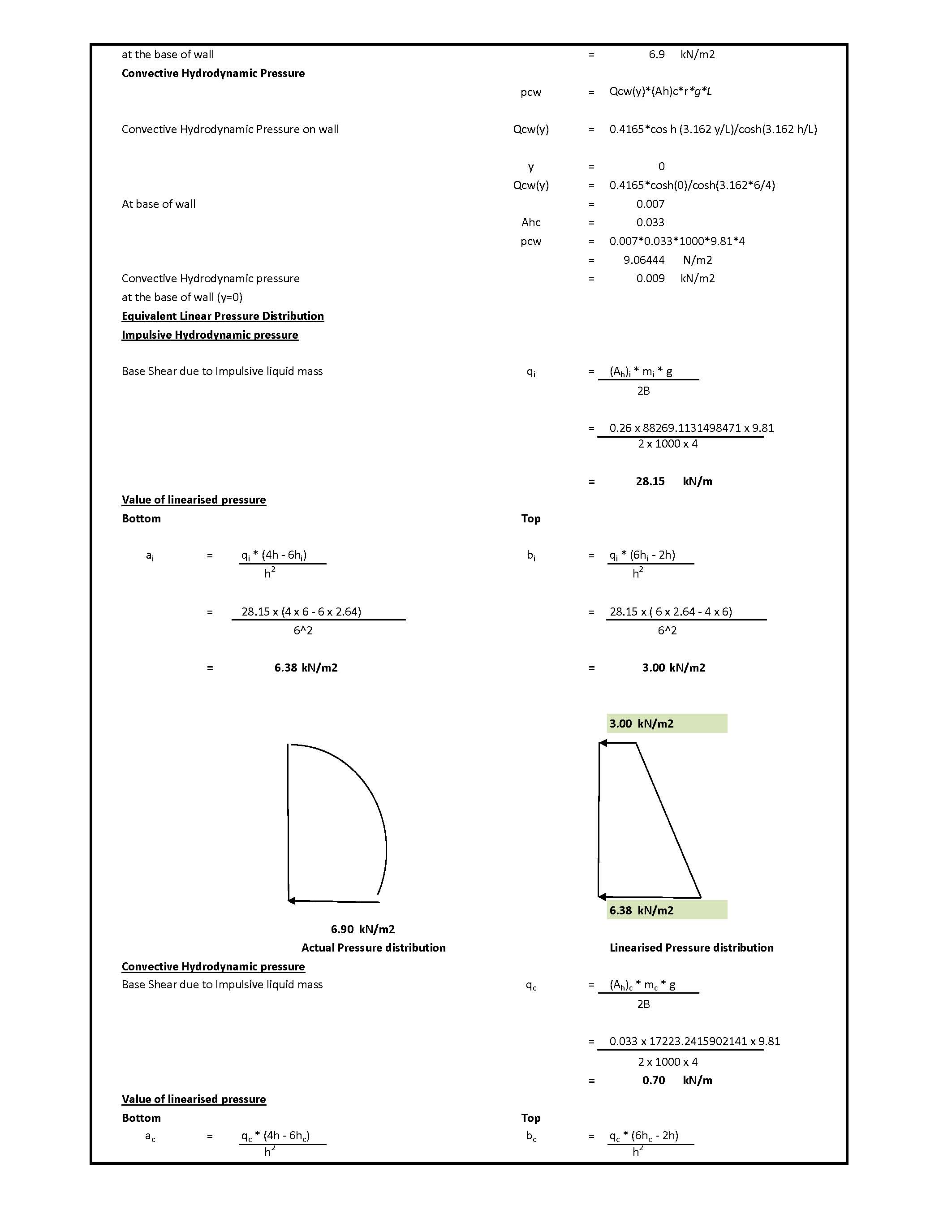
Hydrodynamic loads for tanks refer to the forces exerted on the tank and its internal or external components due to fluid motion, especially during dynamic events like earthquakes, wave action, or fluid sloshing. These loads are critical in designing tanks (such as water tanks, oil tanks, or storage reservoirs) to ensure structural safety and stability.
🔍 Sources of Hydrodynamic Loads
- Seismic Activity
- Causes fluid sloshing and convective/inertial forces.
- Wave Action (for offshore tanks)
- Wave impact, surge, and drag.
- Fluid Movement Inside Tank
- Sudden filling or emptying of tanks.
- Pressure waves and turbulence.
- Wind-Driven Rain Impact
- In special cases with high-speed winds and open tanks.
📐 Key Components of Hydrodynamic Load (Especially During Earthquakes)
As per IS 1893 (Part 2): 2014 and ACI 350.3 / ASCE 7, hydrodynamic load due to earthquake shaking is divided into:
1. Impulsive Load (Hi)
- Due to the portion of fluid that moves with the tank wall.
- Acts at a lower height (below tank center).
- Modeled as a mass rigidly attached to the wall.
2. Convective Load (Hc)
- Due to sloshing of the liquid.
- Acts at a higher point.
- Modeled as a mass on a spring (vibrates independently).
3. Total Base Shear and Overturning Moment
- Combined from impulsive and convective components.
📘 Code References
- IS 1893 (Part 2): 2014 – For design of liquid-retaining structures under seismic loading.
- ACI 350.3-06 – Seismic design of liquid-containing concrete structures.
- ASCE 7-22 – Minimum Design Loads including hydrodynamic pressure.
🧮 Formulas (As per IS 1893:2014 – Part 2)
Impulsive and Convective Mass:
Mi=αi⋅M
Mc=αc⋅M
Where:
- M= Total mass of liquid
- αi, αc = Code-specified coefficients
Hydrodynamic Pressure:
p(z)=ρ⋅a⋅h(z)p(z) = \rho \cdot a \cdot h(z)p(z)=ρ⋅a⋅h(z)
Where:
- ρ = density of fluid
- a = ground acceleration
- h(z) = height-dependent function of pressure
🏗️ Design Considerations
- Tank geometry (cylindrical, rectangular, etc.)
- Height-to-diameter ratio
- Freeboard for sloshing
- Tank flexibility (rigid or flexible)
- Foundation restraint
Related Posts:
4 responses to “Hydrodynamic Load on Tanks | Convective and Impulsive |”
This is a really good tip particularly to those
fresh to the blogosphere. Simple but very
precise info… Appreciate your sharing this one.
A must read post!
Hey very nice blog!
Thanks
What’s up to every body, it’s my first go to see of this blog; this
website consists of amazing and genuinely good stuff in favor
of visitors.